About Staurois tuberilinguis Boulenger, 1918
Tadpole Morphology Comparison
This section compares tadpole morphology of Staurois parvus and Staurois tuberilinguis. S. parvus tadpoles have a strongly depressed body, small subcutaneous eyes, tiny external nares, a worm-like (vermiform) shape with a long tail and reduced fins, and nearly unpigmented skin.
Tadpole Species Differentiation
S. parvus and S. tuberilinguis tadpoles are nearly indistinguishable, but S. parvus has scattered isolated white acini on its body and tail, while S. tuberilinguis does not.
Adult Body Size
For adult S. parvus, males have a snout-vent length of 27–31 mm (1.1–1.2 in) and females have a snout-vent length of 33–38 mm (1.3–1.5 in).
Distinguishing Adult Features
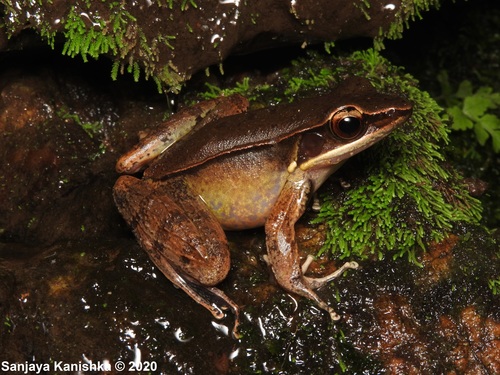
The species can be distinguished from its close relatives by its markedly slender head, pointed snout, and rather short fourth finger. Its vomer has no teeth, and it has a lingual papilla.
Reproductive and Adhesive Traits
Its eggs are unpigmented. The ventral surface of the frog's toes has an array of nanopillars that act as a reversible adhesive, allowing S. parvus to stay steady even in running water.
Species Distribution
S. parvus is found in northern Borneo, in Sabah and Sarawak (Malaysia), Brunei, and northeastern Kalimantan (Indonesia), at elevations up to 2,000 m (6,600 ft) above sea level.
Taxonomic History
It was initially described as a smaller relative only known from Sabah's Crocker Range (Malaysia), later considered a junior synonym of S. tuberilinguis, and recently confirmed as a distinct species based on morphological and DNA sequence data.
Habitat
This frog is commonly found along the banks of small, rocky clear-water streams in primary rainforests. It is often seen perched on rocks or other vegetation near water, typically around rapids.
Breeding and Communication
It breeds in streams, and males vocalize during the day. Like other members of the genus Staurois, it uses visual signalling to attract mates.
Ontogenetic Color Change Overview
Ontogenetic development in S. parvus follows specific color changes. Newly metamorphosed juvenile S. parvus have white and bluish coloration on their feet that aids visual signaling.
Maturational Foot Color Shift
As individuals mature from juvenile to adult, this foot coloration becomes brighter to increase visual conspicuousness. Meta-analytical studies show that this ontogenetic color change occurs alongside sexual development and maturity in S. parvus.
Juvenile Camouflage Coloration
Juvenile S. parvus are bright green, a color that provides camouflage because the species lives on mossy rocks next to rivers and streams in rainforest environments.