About Spilocuscus maculatus (É.Geoffroy Saint-Hilaire, 1803)
Size Comparison
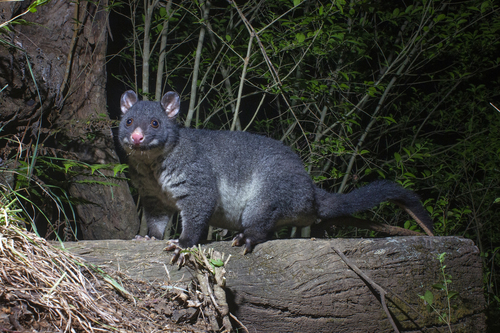
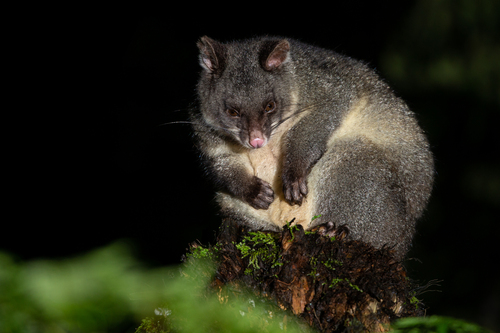
The common spotted cuscus, Spilocus maculatus, is roughly the size of a common house cat.
Body Measurements
It weighs between 1.5 and 6 kilograms (3.3 to 13.2 lb), has a body length of 35 to 65 centimetres (14 to 26 in), and a tail that measures 32 to 60 centimetres (13 to 24 in) long.
Head and General Morphology
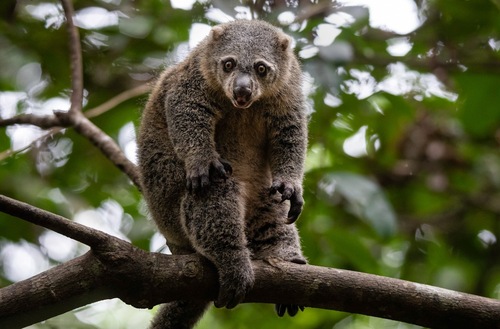
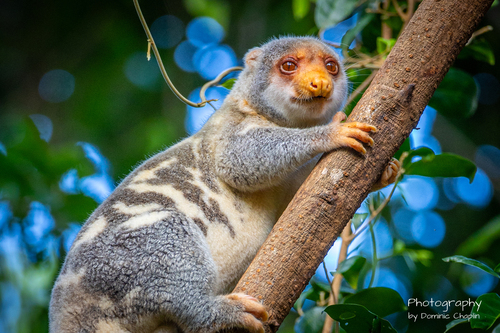
It has a round head, small hidden ears, thick fur, and a prehensile tail that helps it climb.
Eye Characteristics
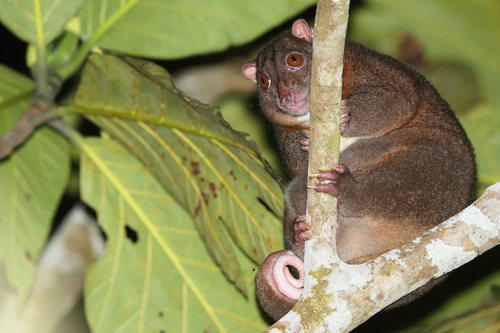
Its eyes come in colors ranging from yellow and orange to red, and have vertical pupils similar to those of a snake.
Limb Claw Structure
All four of its limbs have five digits, most with strong, curved claws, except for the first digit on each foot.
Hind Foot Syndactyly
The second and third digits of the hind foot are partly syndactylous: they are connected by skin at the top joint, but separate at the claws. These smaller claws can function as hair combs during grooming.
Fore Foot Adaptations
The first and second digits of the fore foot are opposable to the other three digits, which helps the cuscus grip branches when climbing.
Paw Surface Structure
The undersides of its paws are bare and striated, which also assists it in grasping trees and food.
Hind Foot First Digit
The first digit on the hind foot is clawless and opposable.
Fur Variation Factors
It has thick, woolly fur that varies in color based on the cuscus's age, sex, and location.
Male Fur Pattern
Males are typically grey-and-white or brown-and-white with splotchy patterns on their back and a white underbelly, and only males have spots.
Female Fur Pattern
Females are usually white or grey and do not have spots. Some fully white individuals are documented in both sexes.
Juvenile Fur Changes
As young cuscuses grow, they go through a series of color changes before reaching sexual maturity at around one year old. Overall, fur coloration can range from red and white to buff, brown, light grey, and black.
Dorsal Stripe Absence
Unlike some other species of cuscuses and possums, the common spotted cuscus does not have a dorsal stripe on its fur.
Tail Specialization
The curled, prehensile tail is a distinctive feature of this species. The upper section of the tail closest to the body is covered in fur, while the lower half has rough scales on its inner surface to help grip branches.
Habitat Types
The common spotted cuscus inhabits rainforests, mangroves, hardwood forests, and eucalyptus forests at elevations below 1,200 metres (3,900 ft).
Habitat Flexibility
Unlike most of its relatives, it is not limited to rainforest environments.
Observability
Because it lives in dense wooded habitats, it is not easily observed, particularly in Australia.
Origin Debate
There is ongoing debate over whether cuscuses originated in Australia and migrated to New Guinea, or the reverse. It is thought that over the past million years, multiple waves of migration occurred during periods of low sea level that exposed seabed across the Torres Strait.
Current Distribution
Currently, the common spotted cuscus lives in Cape York, Queensland, in northeastern Australia, as well as New Guinea and nearby smaller islands. Its range extends as far west as Sulawesi and as far east as the Solomon Islands.