About Sphoeroides annulatus (Jenyns, 1842)
Species Nomenclature
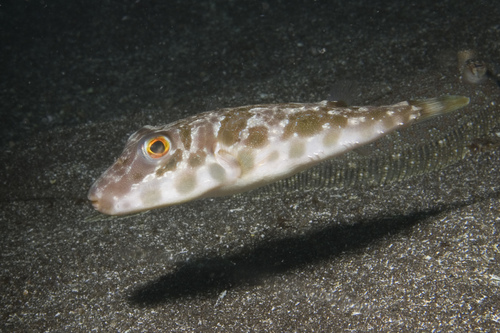
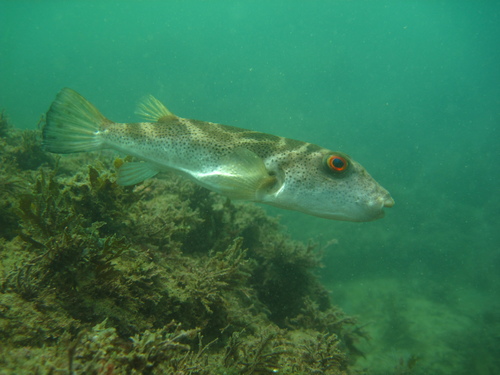
Sphoeroides annulatus (Jenyns, 1842), commonly called the bullseye puffer, has a moderately elongated body, where body depth makes up 25% to 33% of the fish's standard length.
Body Coloration
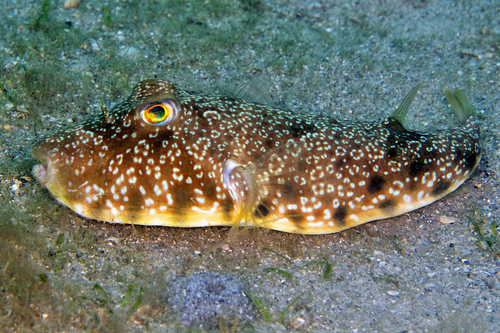
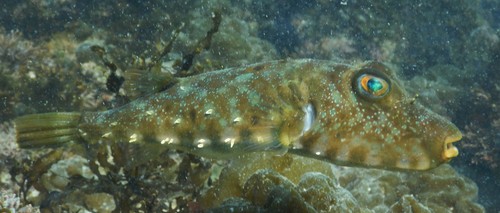
Its back is olive-brown, while its flat ventral side is white.
Head and Back Markings
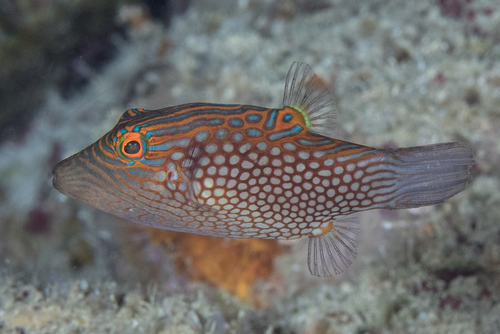
Narrow yellowish lines, bars, and oblique bands mark its head and back, plus 3 narrow bands located behind the eyes.
Distinctive Dorsal Marking
A double concentric oval on its back resembles a bullseye, though this marking can be obscure in large adult individuals.
Dark Spot Distribution
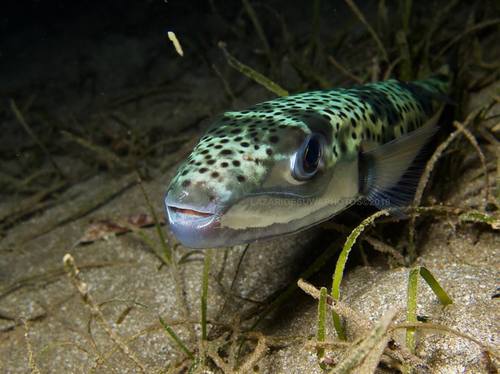
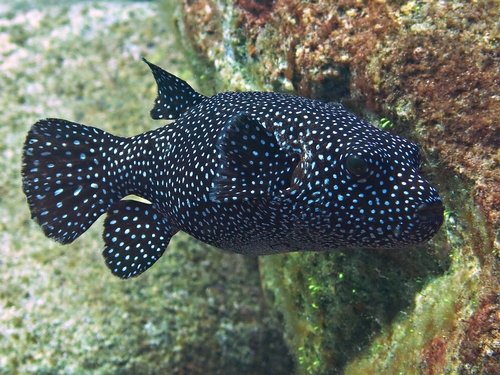
Small dark spots cover its head, sides, and upper back.
Iris and Fin Coloration
It has a yellow iris and completely spotless fins.
Head Morphology
Its head is large, projecting, and blunt; the gap between its elevated eyes is wide and convex.
Dentition
It has powerful, strong teeth.
Dorsal and Anal Fin Structure
Its small dorsal and anal fins, which have 6 to 9 rays each and short bases, are positioned far back on the body; the anal fin sits slightly behind the dorsal fin.
Caudal and Pelvic Fin Structure
Its caudal fin is bluntly convex, and it has no pelvic fins.
Skin and Spines
Small spines cover the head and body, and its skin is scaleless.
Maximum Length
This species can grow to a maximum length of 48 cm.
Genus Global Diversity
The genus Sphoeroides contains 23 recognized species globally.
Genus Distribution in Mexican Waters
Eleven of these species occur in Mexican waters: six in the Atlantic Ocean and five in the Pacific Ocean.
Genus Distribution in Northwest Mexican Pacific
Three puffer species from this genus are found along the north-west Mexican Pacific coastline.
Species Geographic Range
Sphoeroides annulatus is distributed across the eastern Pacific Ocean, ranging from southern California, USA, to the coasts of Peru, and including the Gulf of California and the Galápagos Islands.
Habitat Substrate Preference
This species lives over sandy bottoms, and occasionally occurs around rocky reefs and adjacent sand patches.
Habitat Camouflage Use
It uses its habitat for camouflage to avoid predators.
Depth Range
It generally inhabits shallow depths, though individuals have been found as deep as 70 meters.
Water Temperature Range
It occurs in subtropical and tropical waters with an average temperature of 25.8 °C.
Ontogenetic Habitat Migration
Young Sphoeroides annulatus are often found in pure freshwater, and migrate to brackish or fully marine water when they reach adulthood.
Hatchery Production Status
Hatchery production of this species' larvae and juveniles has been successfully achieved, which supports mass production to supply fish farms with juveniles for commercial-scale growing.
Congeneric Reproductive Traits
Parental investment is documented for Sphoeroides maculatus, a related species in the same genus, where males guard eggs until they hatch; other Sphoeroides species spawn between May and August in shallow sandy or muddy water.
Aquaculture Feed Acceptance
In aquaculture settings, Sphoeroides annulatus can ingest feed particles that float on the water surface, sink through the water column, or rest on the seabed.
Aquaculture Feed Research
Studies are currently in progress to evaluate the suitability of feeding floating feed, sinking feed, or a combination of the two for this farmed species.
Wild Diet
In the wild, this species feeds on insects, crustaceans, and small fish, and uses its beak-like mouth to remove shellfish from their shells.