About Arothron meleagris (Anonymous, 1798)
Color Variation Overview
Arothron meleagris has three common distinct color variations, plus several rare additional patterns.
Dark Base Color Morph
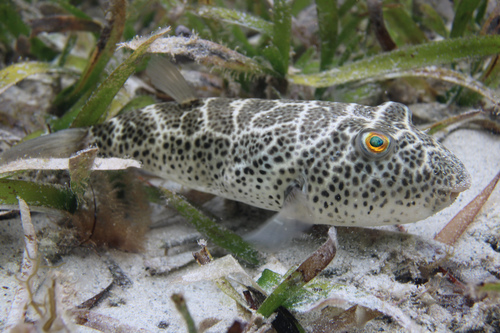
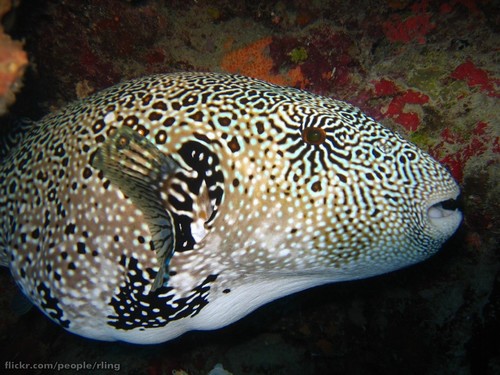
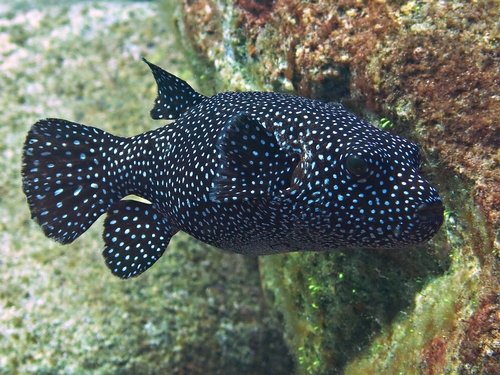
The most common variation, found in 79% of studied individuals, has a dark brown base color covered mostly in white spots, with far fewer black or dark brown spots, across the entire body. Spots on the rear of the body are smaller than spots on the sides, and this size difference is especially common among individuals from the Indian Ocean. Most specimens in this variation have pale dark brown fins marked with white spots matching those on the body.
Dark Morph Pectoral Fin Features
Pectoral fin width varies between individuals, and some individuals have dark brown coloration on the bottom half of the pectoral fin base.
Yellow Base Color Morph
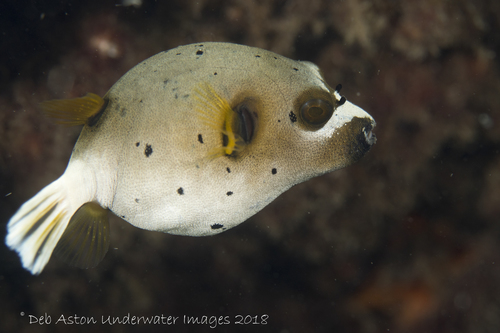
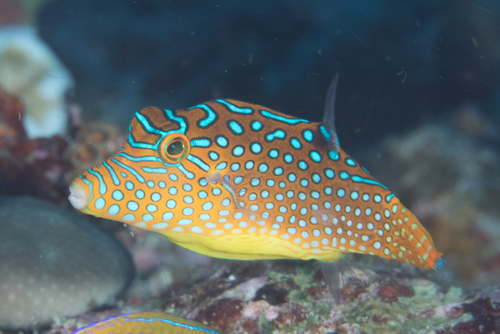
The second equally common variation, found in 10% of studied individuals, has a yellow base color covered with black spots across the body. As noted by Jinxiang and Tyler, the distal edges of the dorsal, anal, and pectoral fins are whitish; the more basal regions of these fins are yellow, with light brown rays toward the distal part of the basal region. The caudal fin is either yellow or a mix of yellow and light brown, and the areas near the gills are light brown.
Mixed Pattern Morph
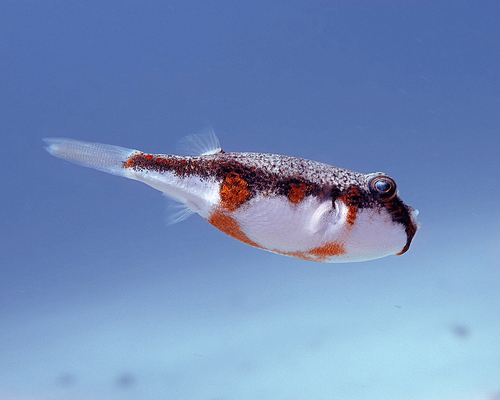
The third variation, found in 11% of studied individuals, is a mix of the two other patterns: a portion of the back is brown with scattered unique white spots, while the sides, belly, and head are yellow with scattered black spots. Light brown patches covered with white spots appear on the mouth, gill openings, and the bottom bases of the dorsal and caudal fins. The anal and pectoral fins are yellow with light brown fin rays.
Mixed Morph Variants
Some other third-variation specimens have bright yellow heads and bodies, with brown fins scattered with white spots.
Rare Abnormal Morph
One rare abnormal specimen, documented by Hector Reyes Bonilla and Arturo Hernandez-Velasco at Cabo Pulma Reef in the southwestern Gulf of California, Mexico, lacked the species' typical white spots and instead had white lines across a black-purple background. This specimen also had a circular black line around its eye, a black belly, white reticulation, a white line on its posterior area, and black stripes over a yellow background on both the dorsal and anal fins.
External Morphology
Like other tetraodontids, A. meleagris has tough skin covered in tiny spiked scales, a beak-like dental plate divided by a median line, and an incision-like gill opening in front of the pectoral fin base. Its jaw bones are modified and fused into a beak structure, with visible sutures dividing the beak into four "teeth" — a feature referenced by the family name Tetraodontidae, from tetra meaning "four" and odous meaning "tooth".
Toxin Storage
A. meleagris can produce and store the toxins tetrodotoxin and saxitoxin in its liver, gonads, and skin, and toxicity levels vary by season and geographic location.
Genome Size
Among members of the Tetraodontidae family, A. meleagris has the smallest vertebrate genomes discovered to date.
Defensive Adaptations Overview
Because Arothron meleagris swims slowly, it relies on other defensive adaptations: modified spiny scales, the ability to inflate its body with water or gas, and tetrodotoxin.
Inflation Mechanism
Inflation occurs when the fish rapidly gulps water into its distensible stomach, which stretches the elastic skin and causes small spinules to stand erect. The result is a spiny ball up to 3 to 4 times the fish's resting volume, which is hard for predators to ingest. The spinules deter predation attempts, lower capture success, and make ingestion difficult for predators.
Tetrodotoxin Properties
Tetrodotoxin (TTX) is a deadly neurotoxin that works by blocking action potentials in nerve and muscle cells, causing rapid muscle weakening and paralysis, including paralysis of respiratory tract muscles that can lead to respiratory arrest and death. In marine pufferfish, TTX accumulates in the liver and ovaries. The toxin is produced by endosymbiotic bacteria that pufferfish consume, after which it bio-accumulates in their bodies.
Toxin Resistance and Use
Pufferfish species that carry TTX are resistant to the toxin's neurological effects, and use it as a chemical defense against predators.
General Distribution
Arothron meleagris is highly abundant on reefs in the Indian Ocean and eastern Pacific Ocean, and less common on the eastern Pacific's rocky reefs.
Population Trends
While its population increased substantially in Costa Rica between 1987 and 2002, it may now be declining due to habitat destruction. The marine aquarium trade may also contribute to population decline, as the species is a high-priced product in this trade.
Coral Reef Habitat Loss Impacts
Coral reefs serve as both habitat and food source for A. meleagris, so coral reef destruction has caused population declines. Starting in 2008, 15% of the world's coral reefs were at risk of becoming effectively lost, meaning 90% of the corals could not recover. As a result of damage and loss to coral reef habitats, A. meleagris populations may decline.
Documented Location List
Documented locations for A. meleagris, recorded by Jinxiang and Tyler, include: Mombasa (Kenya), Comoro Islands, Aldabra Atoll, Seychelles Islands, Chagos Archipelago, Cocos-Keeling Islands, Indonesia, Philippines, South China Sea, Ryukyu Islands, Guam Island, Marshall Islands, Gilbert Islands, Howland Island, Fiji, Caroline Islands, Samoa, Hawaiian Islands, Easter Island, Clarion Island, Revilla Gigedo Islands, Clipperton Island, Galapagos Islands, Gorgona Island, Bahia Pinas (Panama), Bahia Solana (Colombia), and La Plata Island (Ecuador).
Range Extent
The species is also found off the coasts of Taiwan and the South China Sea, and ranges from Guaymas, Mexico to Ecuador. It is not found in the East Indian region except for Christmas Island.
Depth and Habitat Preference
Arothron meleagris is very abundant around oceanic islands, and occurs at depths from 3 to 24 metres (10 to 80 ft).
Aquarium Trade Presence
Outside of its natural habitat, it is held by aquarium companies and sold in retail shops for a high price.
Conservation Status
Overall, the species remains very common with a stable population, and is listed as Least Concern on the IUCN Red List of Threatened Species.
Solitary Behavior
Arothron meleagris is a very solitary pufferfish, similar to Arothron hispidus.
Comparison to Arothron hispidus
A. hispidus is inactive at night, and typically found swimming below ledges and crevices on Kona reefs, among boulders and corals, during the day, and inflates its body to increase its size and reduce the risk of being eaten, just like A. meleagris.
Swimming Locomotion
Arothron meleagris generates propulsive thrust through synchronized lateral oscillations of its dorsal and anal fins.
Steady Swimming Posture
When swimming forward at a steady depth and speed, the long axis of its body is angled 3 to 10 degrees upward from horizontal. The angle of incidence for specific swimming patterns stays constant, and does not change with swimming speed.
Resting Body Shape
When the fish is not moving, its body is shaped like a prolate spheroid.
Body Shape Changes with Speed
As swimming speed increases, the body deforms, and irregularities are mostly limited to the antero-ventral profile. At low swimming speeds, the body shape matches that of a resting or floating fish. As swimming speed increases, the anterior ventral area compresses, forming a pointed apex ventral to the pectoral fins.
High Speed Swimming Feature
As noted by Gordon, Plaut, & Kim, at a speed of 2.0–2.5 body lengths per second, the fish opens its mouth widely enough to show its sharp, broad incisor teeth that project forward.
Diet Composition
The diet of Arothron meleagris consists mainly of corals and invertebrates including tunicates, crustose coralline algae, sponges, and echinoids, and varies based on coral abundance at different reefs such as La Azufrada.
Dietary Generalist Strategies
In some areas, it is a passive generalist that eats corals in proportion to their local abundance, while in others it is an active generalist that expands its dietary preferences to feed only on uncommon corals. Coral reefs are a primary food source for this species and support its growth.
Diet Variation Drivers
Food availability affects the species' diet, because predation pressure from A. meleagris rises or falls as the overall population of its prey changes. A 1989 study by Guzman and Robertson showed that A. meleagris diet variation depends on food availability.
Caño Island Diet Shift Example
For example, the 1985 red tide at Caño Island severely reduced the population of Pocillopora, the coral species this pufferfish feeds on most heavily. In response, A. meleagris changed its feeding habits and consumed large amounts of crustose coralline algae, which was abundant but lower quality than Pocillopora. The species later switched to feed on Porites, the next most available healthy coral, and developed a strong preference for Porites.
Location-Based Diet Differences
At Caño Island, algae makes up a major part of the diet, and the fish feeds on algae continuously even when corals are abundant. By contrast, A. meleagris rarely eats algae at Uva and Secas reefs, and prefers to feed on corals there. At Panamanian locations and Cocos Island, the species acts as a passive generalist, while at Caño Island it acts as an active generalist.
Feeding Preference Variability
As a result, feeding preferences and habits for A. meleagris vary widely, depending on factors including location and local food availability.
Aquarium Trade Volume
Arothron meleagris is traded in the aquarium industry. Between 1967 and 2003, 3,813 individuals were exported to the United States, with a total value of $8,069.70.
Current Market Pricing
Individual specimens currently sell for $199.95 to $399.99 in the aquarium trade. Yellow-colored variations of the species are particularly sought after, and can reach prices of US$500.