About Sphaeralcea parvifolia A.Nelson
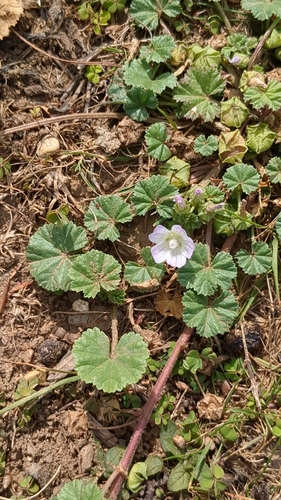
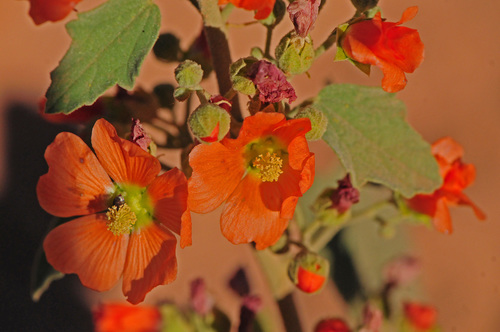
Sphaeralcea parvifolia, also known as small-leaf globemallow, is a perennial plant. Its stems grow upright, reaching a maximum height of 1 meter (3.3 ft), though they more commonly grow between 15 and 40 centimeters (6 and 16 in) tall. Stems emerge from a branched, slightly woody underground structure called a caudex. The stem surface is covered in short, fine hairs that range in color from white to yellow. The leaves of this species are typically ovate (egg-shaped), with their widest point between the leaf midpoint and base. They may also be nearly circular, kidney-shaped, or intermediate between heart-shaped and egg-shaped. Leaf margins can be smooth, or bear three to five shallow lobes. Leaf color ranges from gray to green, and leaves measure 1 to 5.5 centimeters long and 1.2 to 5.2 centimeters wide. Leaves emerge in spring and die back in summer to help the plant conserve water; the stems do very little photosynthesis. Sphaeralcea parvifolia grows across much of the Four Corners region of the United States, extending west to the Sierra Nevada. It is found throughout Nevada, across most of Utah and Arizona, and in western Colorado and western New Mexico. It also occurs in Idaho, where Plants of the World Online lists it as an introduced species. It grows in especially high abundance in north-central and northern Arizona. Its typical habitats include salt desert shrub communities, blackbrush, sagebrush, and pinyon–juniper woodlands. It also grows frequently alongside roads, at elevations ranging from 1500 to 2100 meters. Ecologically, small-leaf globemallow is a host plant for common checkered-skipper caterpillars, along with many other species in the mallow family. In cultivation, small-leaf globemallow is used in xeriscape gardening and as a naturalizing plant. It prefers productive fertile soils over barren soils, and is winter hardy in USDA zones 5 through 10.