About Androcalva rossii (Guymer) C.F.Wilkins & Whitlock
Growth Form
Androcalva rossii is a spindly shrub or small tree that usually reaches 4–10 m (13–33 ft) in height and 2–6 m (6 ft 7 in – 19 ft 8 in) in width.
New Growth Characteristics
It forms suckers, and its new growth is covered in rust-coloured, woolly, star-shaped hairs.
Leaf Shape and Size
Its leaves are egg-shaped, 65–250 mm (2.6–9.8 in) long and 28–150 mm (1.1–5.9 in) wide, growing from a 9–20 mm (0.35–0.79 in) long petiole.
Stipule Features
Triangular stipules 3–10 mm (0.12–0.39 in) long are present at the base of each leaf.
Leaf Surface and Edges
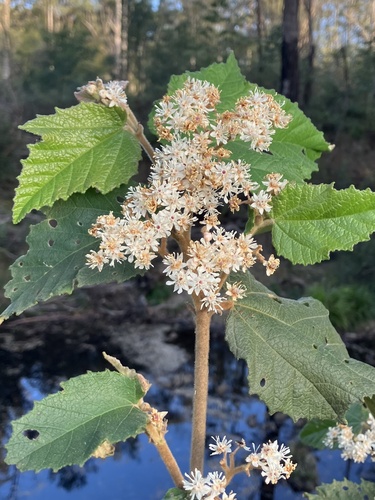
Leaf edges have irregular teeth, and both leaf surfaces are covered with star-shaped hairs, with a denser covering on the lower surface.
Inflorescence Structure
Flowers are arranged in groups of 18 to 60, forming clusters 35–90 mm (1.4–3.5 in) long on a 5–22 mm (0.20–0.87 in) long peduncle.
Individual Flower Stalks
Each individual flower sits on a 3–8 mm (0.12–0.31 in) long pedicel, with bracts 2–10 mm (0.079–0.394 in) long at its base.
Flower Color and Sepals
The flowers are white or cream-coloured, 9–11 mm (0.35–0.43 in) in diameter, and have 5 petal-like sepals that are sometimes pale pink.
Sepal Lobe Size
Sepal lobes measure 3.5–4.5 mm (0.14–0.18 in) long.
Petal and Staminode Features
Petals are white with three lobes, and the staminodes also have three lobes that are longer than the sepal lobes.
Flowering Period
Flowering takes place from August to January.
Habitat and Distribution
Androcalva rossii grows in forest and on rainforest margins, ranging from near Sydney in New South Wales to far eastern Victoria.