About Spermophilus xanthoprymnus (Bennett, 1835)
Body Shape
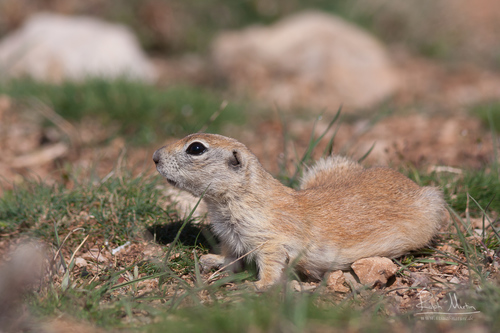
Like many other ground squirrels, the Asia Minor ground squirrel (Spermophilus xanthoprymnus) has a rounded body and head, with short limbs and tail.
Size and Sexual Dimorphism
Males are noticeably larger than females: males measure 25 to 29 centimetres (9.8 to 11.4 in) in total length and weigh 235 to 490 grams (8.3 to 17.3 oz), while females measure 23 to 28 centimetres (9.1 to 11.0 in) and weigh 170 to 410 grams (6.0 to 14.5 oz).
Tail Length
The species' tail is 3 to 6 centimetres (1.2 to 2.4 in) long.
General Fur Pattern
Most of the body has uniformly coloured fur, without the darker markings seen in neighbouring species such as the European souslik.
Fur Coloration
Asia Minor ground squirrels are typically buff in colour, but their colour can range from greyish to dark brown. The underside and limbs are somewhat paler than the rest of the body, often taking a yellowish colour.
Distinct Markings
The only distinct markings are narrow white rings around the eyes, and a white patch on the chin and throat.
Sexual Characteristics
Females have eight or ten teats, and both sexes have scent-producing anal glands.
Core Distribution Range
Asia Minor ground squirrels are found throughout central and eastern Anatolia in Turkey, with their range extending into Iran and Armenia at the eastern edge of their distribution.
Isolated Populations
Small, isolated populations also occur in the Antalya and Çukurova plain regions of southern Anatolia, but the species is not found in near-coastal regions or European Turkey.
Habitat and Elevation
They live in steppe country and alpine meadows, at elevations between 800 and 2,900 metres (2,600 and 9,500 ft).
Subspecies Taxonomy
While two subspecies of Asia Minor ground squirrel were formerly recognized, one inhabiting the northwest highlands of Anatolia and the other the central lowlands, there is little scientific evidence to support these as distinct identities.
Primary Diet
The species feeds primarily on seeds, leaves, and shoots of hardy plants including cocklebur, star-thistle, shepherd's purse, mustard, wild onion, speedwell, and wild grains, alongside domesticated crops. Although it is primarily herbivorous, it may also eat small invertebrates.
Water Acquisition
Due to the relatively arid conditions of its preferred habitat, it rarely, if ever, drinks free-standing water, and gets all the water it needs from its food.
Natural Predators
Its natural predators include eagle owls, buzzards, falcons, and red foxes.
Mating Period and Behavior
Asia Minor ground squirrels mate underground shortly after emerging from hibernation in March or April. During the mating season, males travel between several females, and may fight with each other for access to mates.
Reproduction and Gestation
Females produce a single litter of three to nine young each year, with most litters containing four or five young, and gestation lasts around 25 days.
Neonatal Characteristics
The young are born blind and hairless, weighing 5 to 7 grams (0.18 to 0.25 oz).
Juvenile Development
Fur starts to grow at 15 days old, and the eyes open when the young are 22–25 days old. By four weeks of age, the young begin to leave the burrow, and they are fully weaned by seven weeks old.