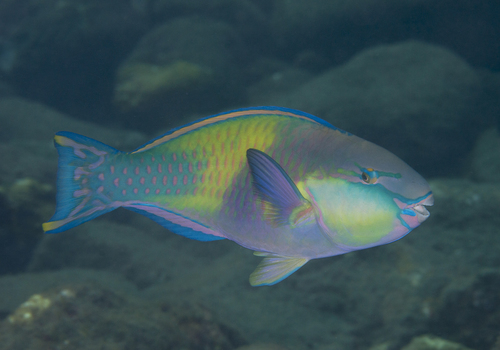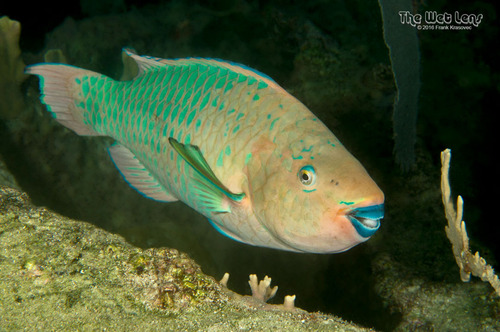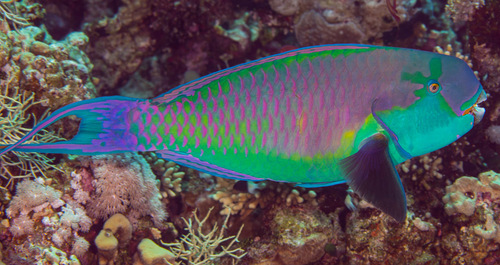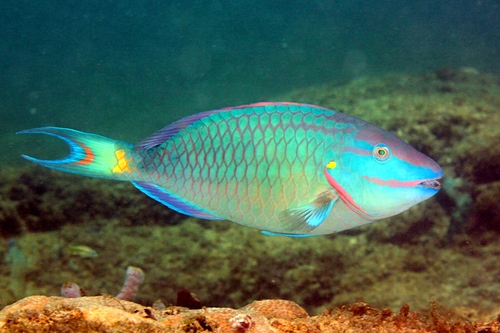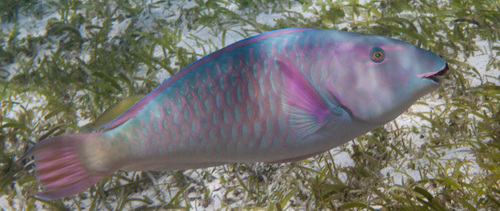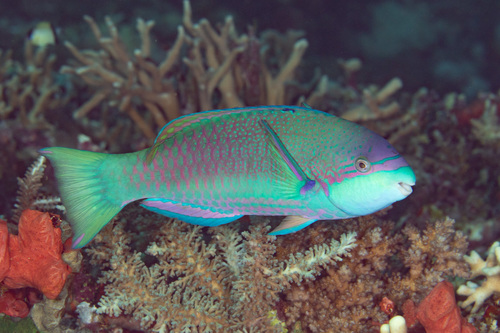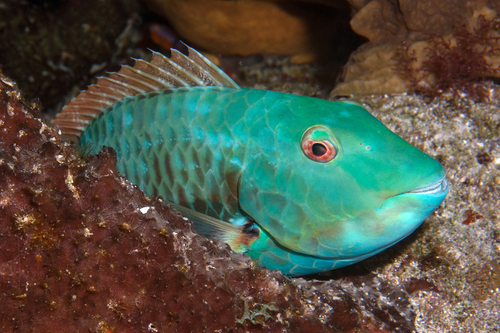
About Sparisoma chrysopterum (Bloch & Schneider, 1801)
Young adult Sparisoma chrysopterum have black saddle-shaped markings at the upper end of their pectoral fin base. Most individuals have a light, saddle-shaped area on the top of their caudal peduncle.
Fin Coloration
Their dorsal, pelvic, and anal fins are orange or red in colour.
Camouflage Pattern
Juveniles and individuals in the initial phase of development have a mottled pattern that matches the surrounding substratum, which gives them camouflage when they rest on the sea floor.
Sparisoma chrysopterum was first described in 1801 by German naturalists Marcus Elieser Bloch and Johann Gottlob Theaenus Schneider under the original name Scarus chrysopterus, with the type locality given as the tropical western Atlantic.
Genus Establishment
When William Swainson established the genus Sparisoma in 1839, he designated Sparus abildgaardi as the genus's type species.
Nomenclature Dispute
While the specific name abildgaardi would technically have precedence over chrysopterum, chrysopterum is the far more widely used name, and abildgaardi was long mistakenly thought to be a synonym of Sparisoma viride.
ICZN Ruling
The International Commission on Zoological Nomenclature suppressed the name Sparus abildgaardi, and formally recognized Scarus chrysopterus as the valid type species of the genus.
Distribution Range
This species is distributed in the western Atlantic Ocean, where it occurs from Brazil in the south northward to Florida and the Bahamas, and is also found throughout the Caribbean Sea.