About Chlorurus japanensis (Bloch, 1789)
Fin and Spine Counts
Chlorurus japanensis (Bloch, 1789) can be distinguished by its fin ray and spine counts: a total of nine dorsal spines, three dorsal soft rays, three anal spines, and nine anal soft rays.
Body Shape
Its body is typically fusiform, or regularly shaped.
Scale Characteristics
Additional distinguishing features include four median predorsal scales, two scale rows on the cheek, and an absence of conical teeth on the side of the lower dental plate.
Dental Plate Features
For the upper dental plate, initial phase individuals have zero to two conical teeth, while terminal males often have two. The lips partially cover the dental plates.
Caudal Fin Shape
Subadults have a caudal fin that ranges from slightly rounded to truncate, while terminal males have a slightly emarginate caudal fin.
Male Coloration
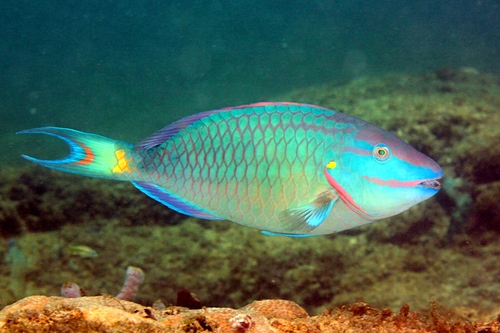
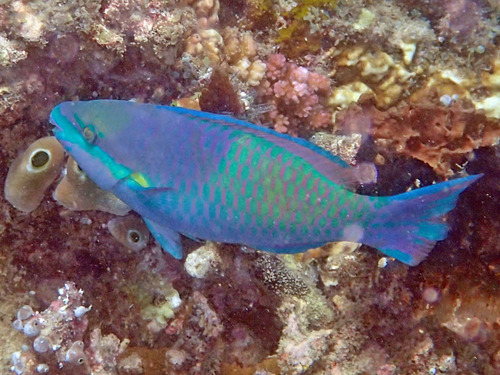
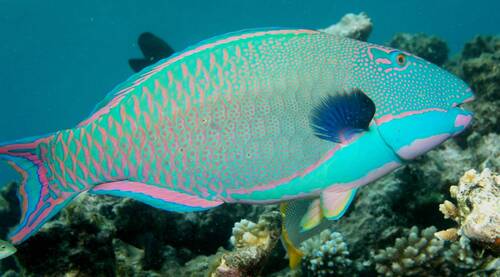
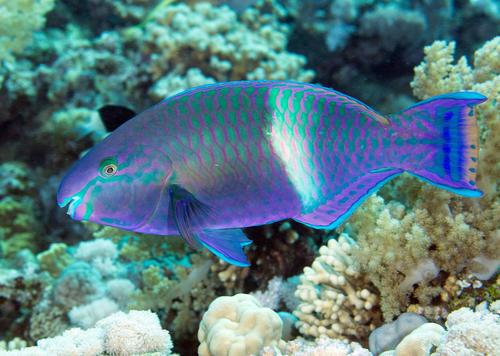
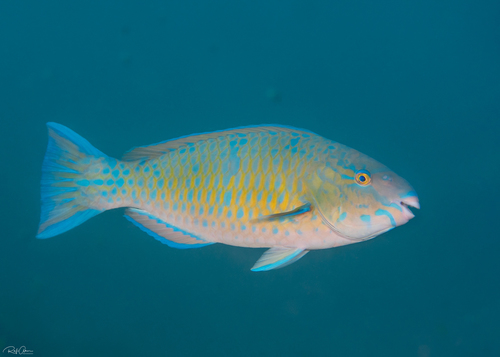
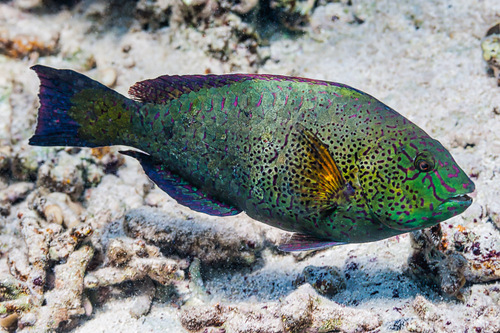
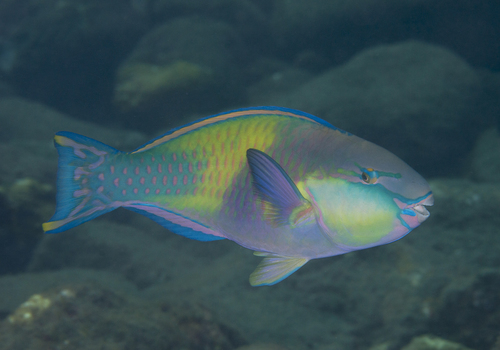
Males are distinctly bicolored, with a purple-brown anterior body and an oblique division separating this section from the pale yellow posterior.
Female Coloration
Females are entirely dark brown, with a red-orange tail.
Main Distribution Range
This species is widespread across the Pacific Ocean, and occurs especially in the region stretching from the Ryukyu Islands to Australia.
New Distribution Records
It has also been recently reported from Tonga.
Reproductive Traits
Chlorurus japanensis is an oviparous species, and typically forms distinct breeding pairs during reproduction.