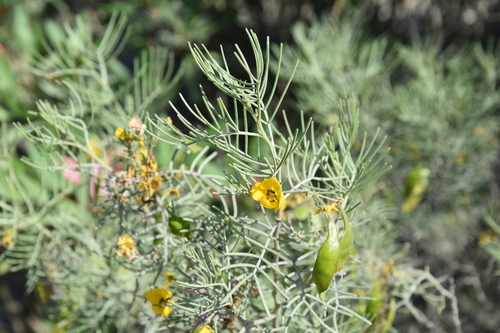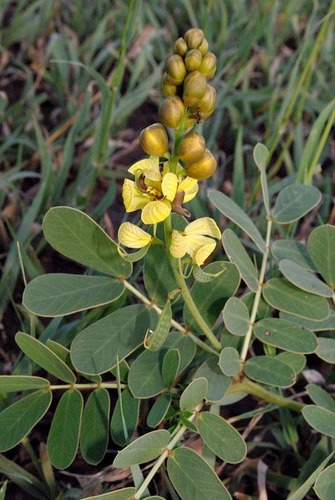
About Senna italica Mill.
Growth Form
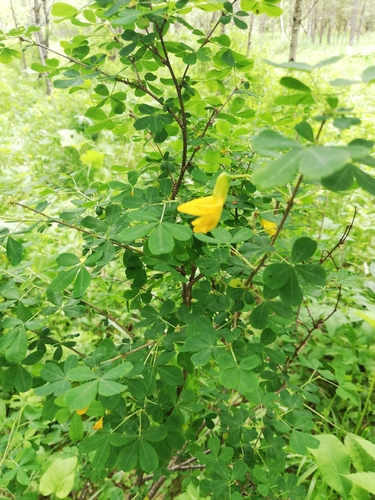
Senna italica Mill. is a deciduous perennial species that grows as either an herb or shrub reaching up to 60 cm tall, with woody tissue throughout its structure and a taproot.
Its stems are solid and typically grow less than 2 m tall; young stems and twigs are either fully glabrous, sparsely glabrous, or covered in sparse to dense hair.
Leaf Structure
This species bears compound leaves with pinnate venation.
Each leaf holds approximately 4 to 6 leaflets, arranged in an alternating spiral pattern.
The leaflets are elliptical in shape and covered in short hair on both sides.
Subspecies arachoides Leaf Gland
For the arachoides subspecies, a small reddish gland is present between each pair of leaflets on the leaf rhachis.
Stipule Characteristics
Stipules are typically lanceolate-triangular, measure 3–9 mm long, and spread outward then bend downward early in development.
Native African Range
Senna italica, commonly called Senegal senna, is native to Africa, ranging from Cape Verde east to Somalia and south to South Africa.
Native Asian Range
It is also native to Asia, ranging from the Middle East through Iran, Iraq, and Pakistan to India and Sri Lanka.
Introduced Range
It has been introduced to the Caribbean, Venezuela, and the United States, where it is currently held at the New York Botanical Garden.
Subspecies italica Distribution
The subspecies S. italica subsp. italica occurs naturally in West Africa, North Africa, Sudan, the Horn of Africa, and from Yemen to northwest India, and is naturalized in parts of South Africa.
Subspecies micrantha Distribution
Subspecies micrantha is found naturally from southern Ethiopia and Somalia southward to Namibia, Botswana, Zimbabwe, and Mozambique, and has also been introduced to India.
Subspecies arachoides Distribution
Subspecies arachoides is restricted to Namibia, Botswana, and South Africa.
Altitude Range
Senna italica grows in grasslands in the drier regions of tropical Africa, at altitudes ranging from sea level up to 1,850 m.
Habitat Preferences
It is most commonly found near streams, in sandy soils, and in disturbed habitats including areas around towns and rural settlements, abandoned gardens, and roadsides.
Climate Adaptation
It is adapted to warm temperatures and can grow year-round.
Pests and Pathogens
Senna italica acts as a host for root lesion nematodes, and serious termite attacks are frequently observed when it is grown as a perennial crop.
Traditional Medicinal Uses
The leaves, pods, and seeds of Senna italica are most commonly used in traditional medicine.
In Malawi, an infusion made from its roots is used to treat infant diarrhea.
Common Vernacular Names
In Bambara, the plant is called mbali or balibali, and in Wolof it is called laïdur.
Forage Suitability
Reports on the usefulness of Senna italica as forage are contradictory: most livestock eat it in East Africa, but it is often avoided in West Africa.
Edible Seed Uses
In the Sahel region, young seeds are eaten as a snack or vegetable, while in Mauritania the seeds are smoked.
Neutral Henna Production
In India, its leaves are used to make a hair treatment called neutral henna or "blonde henna".
Neutral Henna Hair Effects
This treatment coats the hair, leaving it looking glossy and thick for several weeks; contrary to its "neutral" name, neutral henna from Senna italica leaves a yellowish tint on hair, unlike the reddish tint produced by traditional henna.
Fruit Cultivation Status
Fruit cultivation for Senna italica is generally not done, because its fruit has a low content of sennosides.