About Senna artemisioides (Gaudich. ex DC.) Randell
Growth Form
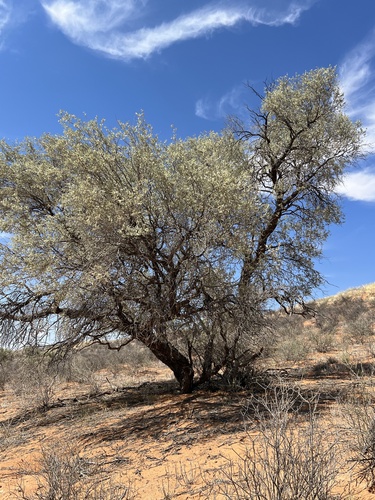
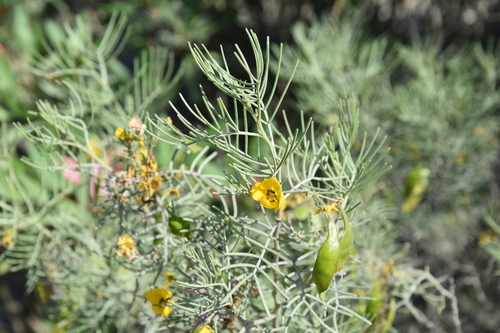
Senna artemisioides is a shrub that typically grows 0.15–3 m (5.9 in – 9 ft 10.1 in) tall, and has pinnate leaves. Its leaflets grow in pairs of 1 to 8, with a sessile gland located between the lowest pair of leaflets.
Stipule Characteristics
The leaves have tiny, triangular stipules that fall off as the leaves mature.
Inflorescence Structure
Yellow flowers grow in clusters of 2 to 15 in leaf axils, on a peduncle up to about 15 mm (0.59 in) long. Each flower sits on a pedicel up to around 10 mm (0.39 in) long.
Flower Parts
The greenish sepals are 6–8 mm (0.24–0.31 in) long, and the petals are 5–10 mm (0.20–0.39 in) long, mostly 7–10 mm (0.28–0.39 in) long.
Stamens
There are ten fertile stamens, with anthers 4–5 mm (0.16–0.20 in) long.
Fruit Characteristics
The fruit is a glabrous, linear pod 5–10 cm (2.0–3.9 in) long and 8–15 mm (0.31–0.59 in) wide.
Native Distribution
This plant, commonly called silver cassia, is endemic to Australia, where it occurs in all mainland states and territories.
Introduced Range
It has also been introduced to California, the Canary Islands, Cyprus, India, Iraq, Spain and Zimbabwe.
Larval Host Role
S. artemisioides is a known larval food plant for multiple species of butterfly and moth, including the small grass yellow, icilius blue, twig looper, blotched satin moth and bag-shelter moth.
Seed Dispersal
Ants aid its seed dispersal by eating the seed arils.
Horticultural Climatic Tolerance
In horticulture, Senna artemisioides adapts to a wide range of climatic conditions, but is susceptible to frost, especially when young.
Preferred Growing Conditions
It prefers dry, well-drained sites with full sun.
Propagation Method
Grown as an ornamental plant, it propagates easily from seed, which should first be briefly soaked in boiling water before sowing.
Horticultural Award
This species has received the Royal Horticultural Society's Award of Garden Merit.