About Selenidera maculirostris (M.H.K.Lichtenstein, 1823)
Size and Weight
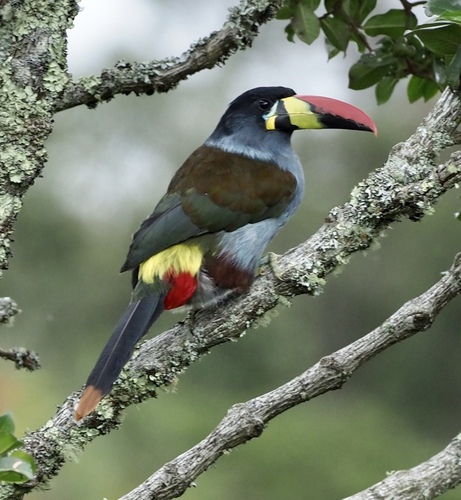
The spot-billed toucanet (Selenidera maculirostris) is 33 to 37 cm (13 to 15 in) long and weighs 137 to 193 g (4.8 to 6.8 oz).
Bill Sexual Dimorphism
Males and females share the same bill pattern, but the female's bill is shorter.
Bill Base Features
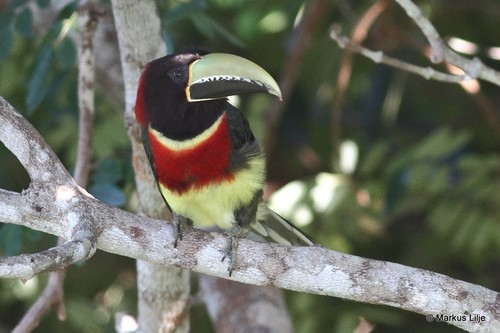
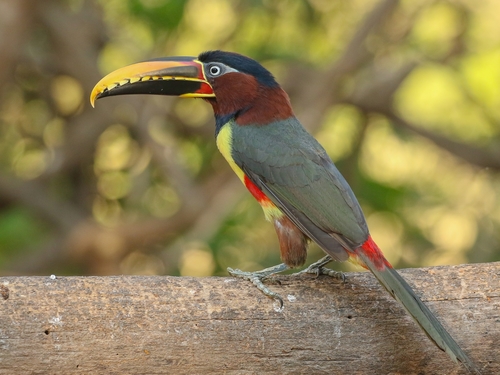
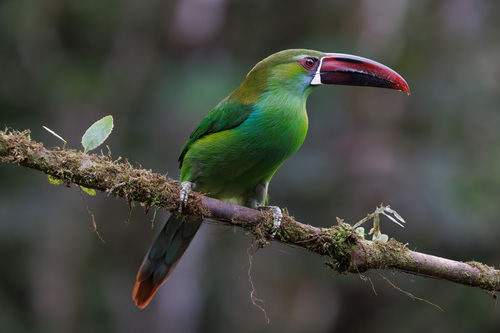
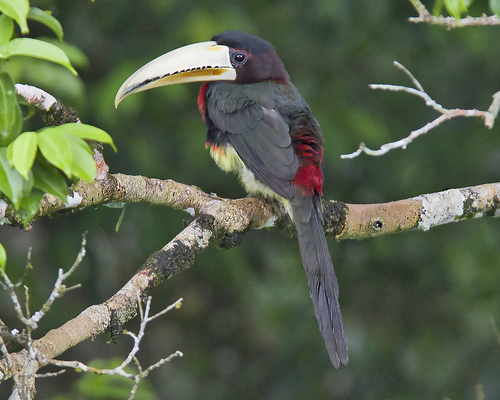
The bill has a thin vertical black line at its base. It is mostly ivory at the base, transitioning to greenish-yellow at the tip.
Bill Markings
The middle of the culmen is black, the maxilla has three to five vertical black stripes, and the mandible has a black patch near its end.
Facial Features
Both sexes have bare green-yellow to blue skin surrounding the eye, and a golden-yellow tuft of feathers behind the eye; both features are paler on females.
Male Plumage (Head and Torso)
Adult males have black coloring on the head, nape, chin, throat, and belly. Their upperparts are green with a yellow band on the lower neck.
Male Plumage (Tail and Lower Body)
Their tail is green, with chestnut tips on the central three pairs of feathers. Their flanks are yellow, and their undertail coverts are red.
Female Plumage
Females have chestnut to cinnamon-rufous coloring in the areas where males have black.
Immature Characteristics
Immature spot-billed toucanets are duller overall, usually lack the yellow band on the back, and do not have sharply defined bill patterns.
Distribution
The spot-billed toucanet is distributed in Brazil, from the states of Bahia and Minas Gerais extending southward, and also occurs in eastern Paraguay and Argentina's Misiones Province.
Habitat
It inhabits the Atlantic Forest, and can be found in old-growth forest, secondary forest, selectively logged forest, remnant forest, palm groves, and gallery forest at the edges of the cerrado.
Elevational Range
Its elevational range extends from sea level to at least 1,000 m (3,280 ft).