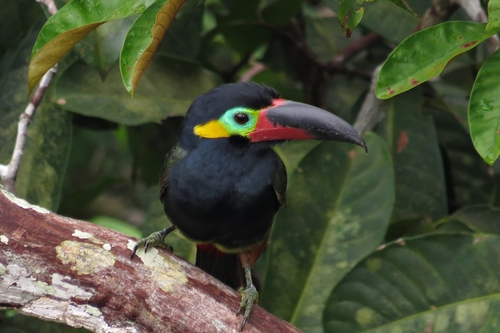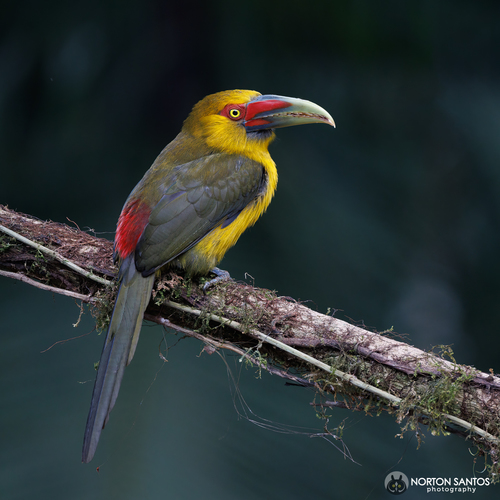
About Pteroglossus castanotis Gould, 1834
Size and Weight
The chestnut-eared aracari (scientific name Pteroglossus castanotis Gould, 1834) measures 43 to 47 cm (17 to 19 in) in length and weighs 220 to 310 g (7.8 to 11 oz).
Bill Sexual Dimorphism
Males and females share the same bill coloration, though the female’s bill is shorter.
Nominate Subspecies Bill Pattern
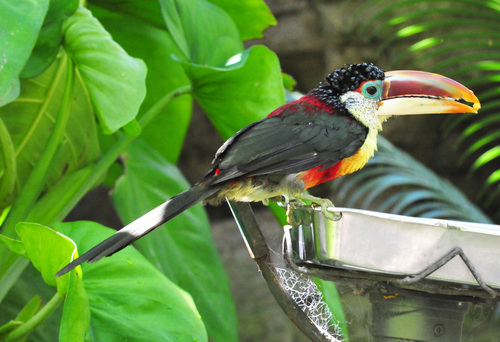
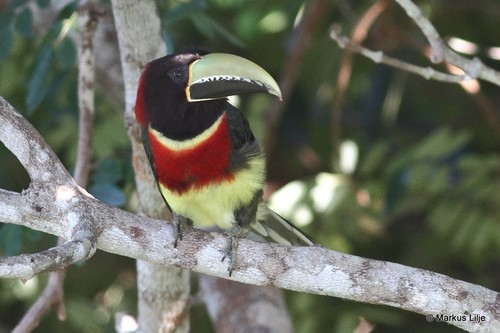
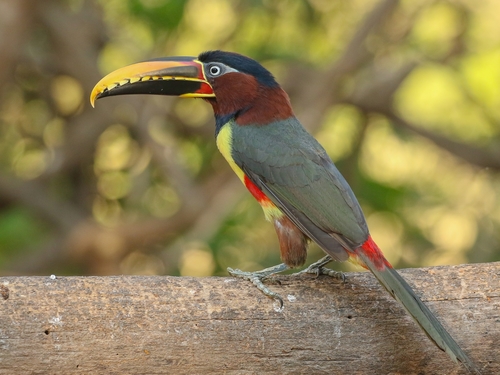
For adults of the nominate subspecies, the bill has a yellow line at its base, and the mandible is mostly black. The maxilla has a black stripe along the culmen and a black triangle that narrows toward the tip, with orange-yellow between these markings. The edge of the maxilla has black and ivory markings that resemble teeth.
Adult Male Plumage
Adult males have a black crown and upper nape, a chestnut lower nape, a dark green back, and a red rump. They have blue facial skin; the sides of the face and upper throat range from brown to chestnut. Their lower throat is black, breast is yellow, lower breast is red and chestnut-black, belly is yellow, and thighs are usually cinnamon.
Adult Female Plumage
Adult females are browner than males on the crown, nape, and upper throat, and the black band on their lower throat is thinner.
Juvenile Characteristics
Juveniles are duller overall, with a muted bill pattern that lacks the tooth-like markings and the yellow basal line.
P. c. australis Plumage
The subspecies P. c. australis is paler overall than the nominate subspecies. Its cheeks and upper throat are rusty, its breast band is red and rufous, and its thighs are green and rusty.
P. c. australis Bill Pattern
Its bill has a wider orange basal line than the nominate, with a red mark next to the line.
Overall Species Range
The chestnut-eared aracari inhabits the western and southern Amazon Basin.
Nominate Subspecies Distribution
The nominate subspecies occurs in the more northerly part of the species’ range, found from southern and eastern Colombia south through eastern Ecuador to southeastern Peru, and east into Brazil along the Amazon to the Rio Negro, as well as into the Brazilian states of Acre and Amazonas.
P. c. australis Distribution
P. c. australis is found south of the Amazon in north central Brazil, ranging south through northern Bolivia, eastern Paraguay, and Misiones Province of northeastern Argentina, into southeastern Brazil as far as Minas Gerais, São Paulo state, and Rio Grande do Sul.
Water-Associated Habitats
The chestnut-eared aracari occupies a wide variety of landscapes, many of which are defined by standing or flowing water. Examples include wet forests beside lakes and rivers, várzea, forested river islands, swamp forest, and gallery forest.
Other Habitat Types
It also occurs at edges, clearings, and disturbed areas of drier forest, in bamboo and canebrakes, in cerrado, and in coffee plantations.
Elevation Range
Most individuals are found below 600 m (2,000 ft) in elevation, but the species occurs up to about 1,300 m (4,300 ft) at some Andean sites, and up to more than 1,000 m (3,300 ft) in southeastern Brazil.