About Andigena hypoglauca (Gould, 1833)
Size and Weight
The grey-breasted mountain toucan, Andigena hypoglauca, is 41 to 48 cm (16 to 19 inches) long and weighs 244 to 370 g (8.6 to 13 ounces).
Plumage Sexual Dimorphism
Within each subspecies, males and females share identical plumage.
Bill Pattern Dimorphism
The two subspecies also have the same bill pattern, though the female’s bill is shorter.
Bill Base Coloration
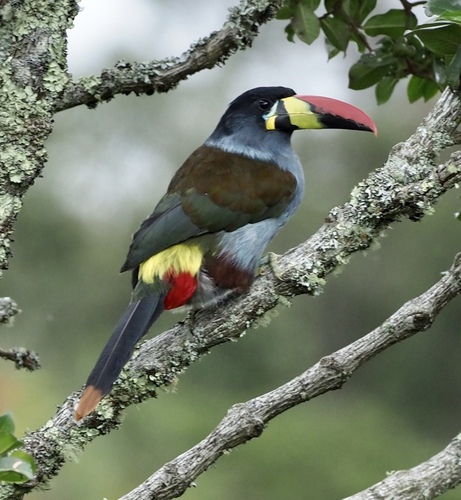
The base of the bill is yellow to greenish, with a black band located close to the base.
Maxilla Coloration
The outer two-thirds of the maxilla is red, meeting the yellow portion of the bill along a diagonal line.
Mandible Coloration
The outer half of the mandible is black.
Shared Subspecies Upperpart Plumage
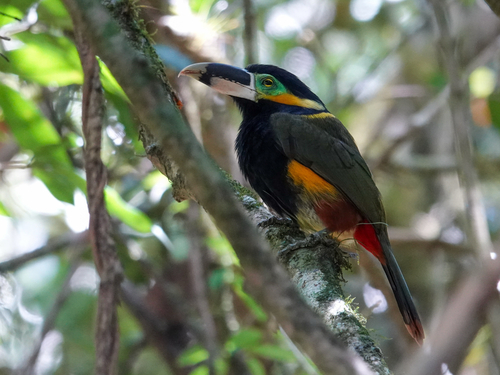
Both subspecies have black caps, faces, and napes; a gray-blue band on the hindneck; a greenish brown back; and gray to gray-blue underparts.
Tail Plumage
Their tail is blackish, with chestnut-colored tips on the two or three central pairs of feathers.
Nominate Subspecies Body Plumage
The nominate subspecies has a bright yellow rump, pale gray-blue flanks, chestnut thighs, and red undertail coverts.
Nominate Subspecies Eye Features
Its eyes are brown, and each eye is surrounded by bare blue skin.
A. h. lateralis Distinguishing Features
Subspecies A. h. lateralis has a paler yellow rump than the nominate subspecies, plus pale yellow to gray-white flanks and a yellow to green eye.
Nominate Subspecies Distribution
The nominate subspecies of the grey-breasted mountain toucan ranges from central and southern Colombia into eastern Ecuador.
A. h. lateralis Distribution
A. h. lateralis ranges from eastern Ecuador south deep into Peru.
Habitat
This species lives in wet temperate montane forest, including cloud forest, elfin forest, and secondary forest.
Elevation Range
Most individuals are found at elevations between 2,200 and 3,650 m (7,200 and 12,000 ft), though the species has been recorded as low as 1,500 m (4,900 ft) in Peru and 1,700 m (5,600 ft) in Ecuador.