About Selar boops (Cuvier, 1833)
Size
Adults of Selar boops typically reach a maximum length of 22 centimetres (8.7 in), but can grow up to 25 centimetres (9.8 in), with a recorded maximum total length of 26 centimetres (10 in).
Fin Morphology
This species has 9 dorsal spines, 23 to 25 soft dorsal rays, 3 anal spines, and 19 to 21 soft anal rays.
Coloration
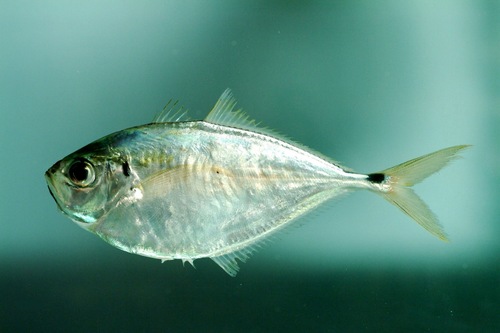
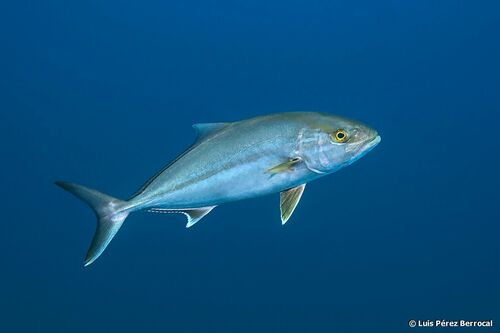
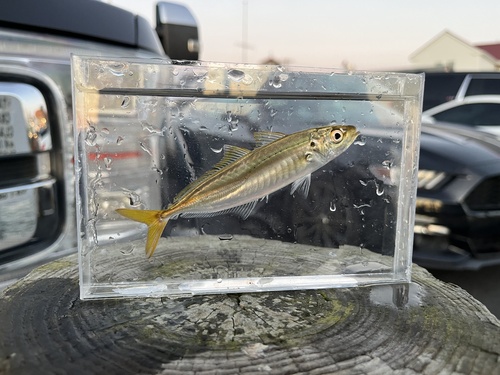
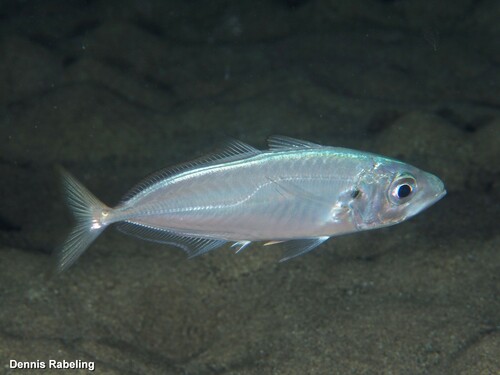
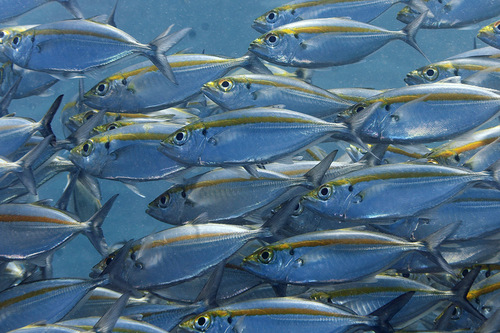
The fish is silvery blue in color, with a horizontal yellow line running along its midsection.
Etymology
It has a notably large eye that makes up approximately one-third of its head; this feature gives the species its specific epithet boops, which combines the words for "ox" and "eye" from Greek.
Indian Ocean Distribution
In the Indian Ocean, Selar boops ranges from Sri Lanka and eastern India to the Andaman Sea, Southeast Asia, and northwestern Australia.
Pacific Ocean Distribution
Additional populations are found in the Pacific Ocean around Southeast Asia, northern Australia, multiple Pacific islands, and Central America.
Habitat Type
Selar boops is most often found over seagrass beds and other soft substrates, though it also occurs on coral and rocky reefs.
Depth Range
It lives at depths ranging from 35 to 500 metres (115 to 1,640 ft).
Feeding Behavior
This species forms large schools during the day; these schools break up at night, when individuals feed on crabs, shrimp, and small fish caught either from the water column or the seabed.
Reproduction
Its eggs are pelagic.
Commercial Significance
Selar boops is a commercially important species targeted by fisheries in some regions of its range.
Fishing Methods
In Indonesia, it is caught using a variety of fishing gear including purse seines, gill nets, lift nets, handlines, and beach seines.