About Chloroscombrus chrysurus (Linnaeus, 1766)
Common Name and Body Profile
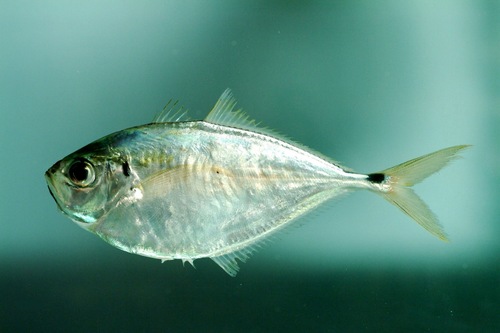
Commonly called the Atlantic bumper, Chloroscombrus chrysurus (Linnaeus, 1766) can be easily identified by its body profile, where the lower edge is much more curved than the upper edge. Its lateral line also forms an arch close to the head.
General Coloration
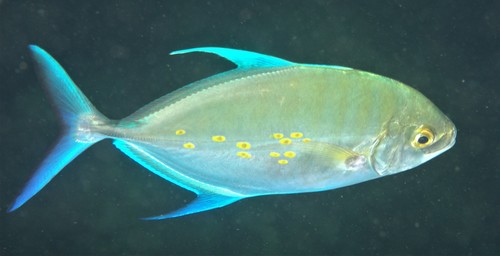
Most Atlantic bumper are silver to golden in overall color, with golden yellow coloring on the anal fin and caudal fin.
Fin Ray and Spine Counts
The anal fin has 3 spines and 25–28 rays, while the caudal fin has 9 spines and 25–28 rays.
Distinctive Markings
A distinct black saddle-shaped blotch appears on the caudal peduncle, and a similar dark patch sits near the edge of the opercle.
Size Measurements
The average length of an adult Atlantic bumper is 25 centimeters (9.8 inches), and the largest recorded individual reached 65 centimeters (26 inches) long.
Western Atlantic Range
In the western Atlantic Ocean, the Atlantic bumper ranges from Massachusetts down to southern Brazil, including populations off Bermuda, in the Caribbean Sea, and in the Gulf of Mexico; its range extends south as far as the coast of Uruguay.
Eastern Atlantic Range
In the eastern Atlantic Ocean, it occurs from the coast of Mauritania to Angola.
Mediterranean Occurrence
There is only one confirmed record of this species in the Mediterranean Sea, documented off the coast of Spain in 1997.
Pacific Ocean Congener
The Atlantic bumper does not live in the eastern Pacific Ocean; that area is home to the visually similar Pacific bumper, Chloroscombrus orqueta.
Taxonomic Relationship
Little is known about the relationship between these two taxa, and they may actually represent just a single species.
Depth Range
The Atlantic bumper inhabits subtropical waters, down to a maximum depth of 55 meters.
Habitat Preferences
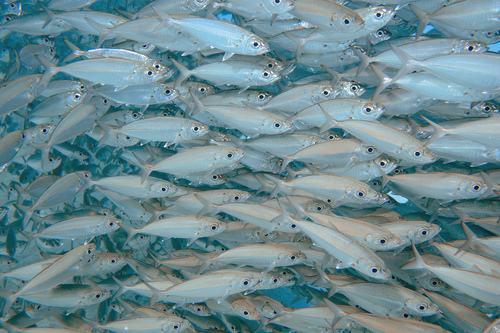
It most often lives close to soft bottoms on the continental shelf, but has also been observed schooling near the water surface.
Salinity Tolerance
It is primarily a marine saltwater species, but juvenile Atlantic bumper have been found in brackish estuaries.