About Caranx melampygus Cuvier, 1833
Scientific Name and Size
The bluefin trevally, scientifically named Caranx melampygus Cuvier, 1833, is a large fish that reaches a maximum known length of 117 cm and maximum weight of 43.5 kg. Individuals longer than 80 cm are rare.
General Body Shape
It shares a similar overall shape with many other large jacks and trevallies, with an oblong, compressed body. The dorsal profile of the body is slightly more convex than the ventral profile, especially toward the front of the body. This slight convexity gives the species a much more pointed snout than most other members of the genus Caranx.
Dorsal Fin Structure
Its dorsal fin is split into two separate parts: the first holds 8 spines, while the second holds 1 spine followed by 21 to 24 soft rays.
Anal and Pelvic Fin Structure
Its anal fin holds 2 anteriorly detached spines, followed by 1 spine and 17 to 20 soft rays. The pelvic fins each contain 1 spine and 20 soft rays.
Caudal and Pectoral Fin Structure
The caudal fin is strongly forked, and the pectoral fins are falcate, and longer than the length of the head.
Lateral Line Structure
The lateral line has a pronounced, moderately long anterior arch; the curved section intersects the straight section below the lobe of the second dorsal fin. The curved section of the lateral line contains 55 to 70 scales, while the straight section contains 0 to 10 scales followed by 27 to 42 strong scutes.
Scale Coverage
The entire chest is covered in scales.
Dentition
The upper jaw holds a series of strong outer canines with an inner band of smaller teeth, while the lower jaw holds a single row of widely spaced conical teeth.
Gill Rakers and Vertebrae
The species has a total of 25 to 29 gill rakers, and 24 vertebrae.
Head Features
A moderately weakly developed adipose eyelid covers the eye, and the back edge of the jaw sits vertically under or just past the front margin of the eye.
Geographical Variation
Across its wide distribution, the only recorded geographical variation is difference in body depth among smaller specimens.
General Body Coloration
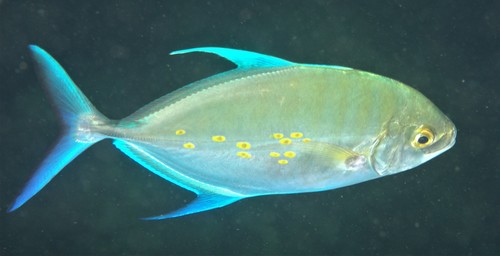
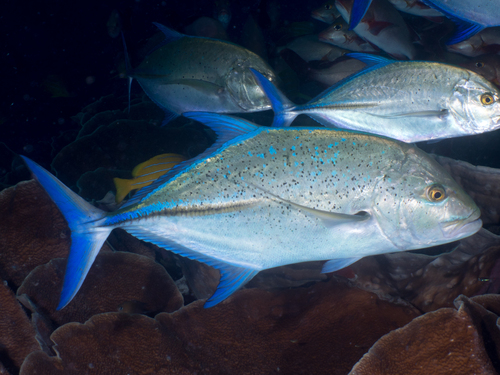
The upper body of the bluefin trevally is silver-brassy, fading to silvery white on the underside, and often has blue hues. Once individuals grow longer than 16 cm, blue-black spots develop on the upper flanks, and these spots become more numerous as the fish ages.
Operculum Marking
There is no dark spot on the operculum.
Fin Coloration
The species gets its name from the diagnostic electric blue color of its dorsal, anal, and caudal fins. The pelvic and pectoral fins are white, with the pectoral fin bearing a yellow tinge.
Juvenile Coloration
Juvenile fish do not have bright blue fins; instead they have dark fins, with the exception of a yellow pectoral fin. Some juveniles have also been recorded with up to five dark vertical bars on their sides.
Overall Distribution Range
The bluefin trevally is widely distributed across the tropical and subtropical waters of the Indian and Pacific Oceans, occurring along the coasts of four continents and hundreds of smaller islands and archipelagos.
Western Indian Ocean Distribution
In the Indian Ocean, the species' westernmost range is the coast of continental Africa, distributed from the southern tip of South Africa north along the east African coastline to the Red Sea and Persian Gulf. Its range extends east along the Asian coastline, including Pakistan, India, South East Asia, the Indonesian Archipelago, and northern Australia.
Australian Indian Ocean Distribution
The southernmost record from the west coast of Australia comes from Exmouth Gulf. Elsewhere in the Indian Ocean, the species has been recorded from hundreds of small island groups including the Maldives, Seychelles, Madagascar, and the Cocos (Keeling) Islands.
Central Indo-Pacific Distribution
The bluefin trevally is abundant in the central Indo-Pacific region, found across all archipelagos and offshore islands including Indonesia, the Philippines, and the Solomon Islands. Along continental Asia, the species has been recorded from Malaysia to Vietnam and mainland China.
Northwestern Pacific Distribution
Its offshore range extends north to Hong Kong, Taiwan, and southern Japan in the northwestern Pacific. In the south, the species reaches as far south as Sydney, Australia.
Eastern Pacific Distribution
Its distribution continues across the western Pacific including Tonga, Western Samoa, Polynesia, and the Hawaiian Islands. The easternmost limit of the species' distribution is the Mesoamerican coastline between Mexico and Ecuador in the central eastern Pacific, including islands such as the Galápagos Islands.
General Habitat Range
The bluefin trevally occurs in a wide range of inshore and offshore marine habitats across its range, including estuarine waters. The species is known to move through the entire water column, but is most often observed in a demersal setting, swimming not far from the seabed.
Inshore Habitat Types
In the inshore environment, the species is present in almost all habitat types including bays, harbours, coral and rocky reefs, lagoons, sand flats, and seagrass meadows.
Juvenile Habitat Preferences
Juveniles and subadults are more common in these inshore settings, and prefer these more protected environments, where they live in water to a minimum depth of around 2 m.
Adult Habitat Preferences
Adults tend to prefer more exposed, deeper settings such as outer reef slopes, outlying atolls, and bomboras, often near drop offs, and the species has been recorded from depths up to 183 m. Adults often enter shallower channels, reefs, and lagoons to feed at certain periods during the day.
Habitat Partitioning with Giant Trevally
The bluefin trevally displays some habitat partitioning with the giant trevally Caranx ignobilis, tending to be more common outside major bays than this relative.
Estuary Habitat Use
Juvenile and subadult bluefin trevally have been recorded in estuaries at several locations, and generally occupy large, open estuaries up to the middle reaches of these systems. These estuaries are often lined by mudflats and mangroves, but the species rarely enters these shallow waters.
Estuary Salinity Tolerance
Individuals between 40 and 170 mm have been recorded in South African estuaries, where they are the least tolerant carangid to the brackish and freshwater conditions of these systems. Bluefin trevally can tolerate salinities between 6.0 and 35 ‰, and only occupy clear, low turbidity waters.
Estuary Residency
There is evidence the species is only resident in these estuaries for short periods. The species is also absent from coastal lakes that many other carangids are known to occupy.
Schooling Behavior
In terms of biology and ecology, the bluefin trevally is a schooling species as a juvenile, and transitions to a more solitary adult fish with well-defined home ranges. Adults do form schools to create spawning aggregations or temporarily while hunting.
Aggregation Cues
Evidence from laboratory studies indicates bluefin trevally are able to coordinate these aggregations over coral reefs based on the release of dimethylsulfoniopropionate (DMSP) from the reef. DMSP is a naturally occurring chemical produced by marine algae, and to a lesser extent by corals and their symbiotic zooxanthellae.
Factors Influencing Local Abundance
The number of fish present in an area is also influenced by tidal factors, and possibly prey abundance and other environmental factors.
Daytime Movement Patterns
Tracking studies in Hawaii have found bluefin trevally patrol back and forth along a home range of patch reef walls during the day, only stopping for variable periods where major depth changes or discontinuities in the reef are present. Several fish patrol the same reef patch, reversing direction where the other individuals do.
Inter-reef Excursions
While most fish patrol only one reef, some have been observed making excursions to nearby reefs before returning to their home reef later.
Nighttime Movement Patterns
Nighttime movements are less extensive than daytime movements: the trevally moves rapidly between several small reef sections, then slows down and mills around in one patch for around an hour. Fish living in a particular region congregate in one area at night, before returning to their individual daytime range during the day.
Nighttime Congregation Purpose
The reason for this nighttime congregation is unclear, but it may be important to the species' social structure.
Long-Term Movement Range
Long-term studies have found the fish may range up to 10.2 km over several months, however it is much less restricted in its movements than its relative, the giant trevally.
Hawaiian Population Abundance
A Hawaiian biomass study found the species to be one of the most abundant large predators in the Hawaiian Islands, however it is less abundant in the heavily exploited Main Hawaiian Islands than in the remote Northwest Hawaiian Islands. The main difference between these populations is the relative lack of large adult fish in inhabited areas compared to remote, unfished regions.
Fishing Tournament Catch Data
A study of carangids caught during a fishing tournament in Hawaii found the bluefin trevally is the most common trevally species taken, accounting for over 80% of the carangid catch. The study authors note this may reflect not only the species' abundance, but also its vulnerability to the specific fishing methods used in the tournament.
Commensal Behavior
Apart from its typical predator-prey relationship (described later), one individual bluefin trevally has been observed rubbing itself against the skin of a Galapagos shark, apparently to remove parasites. This behaviour is also seen in rainbow runner, and is a rare example of a commensal cleaner relationship where the cleaner does not gain any benefit.