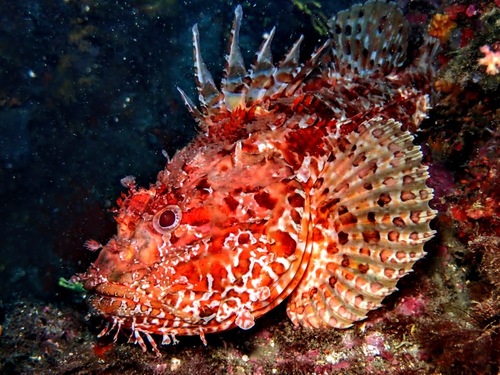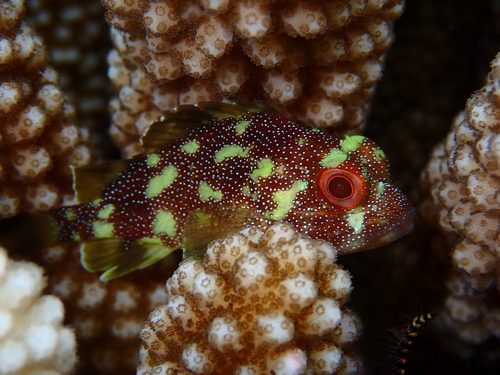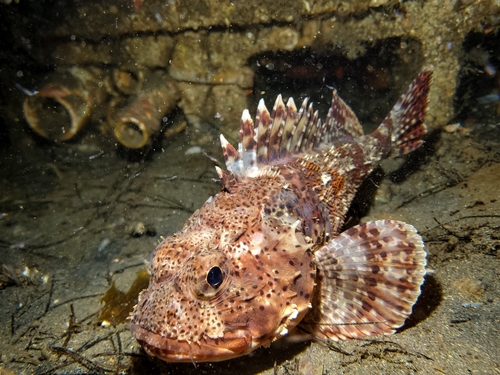
About Scorpaena guttata Girard, 1854
Size
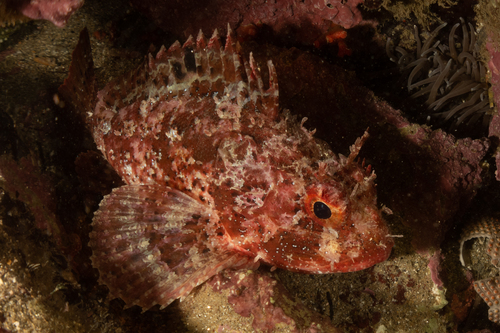
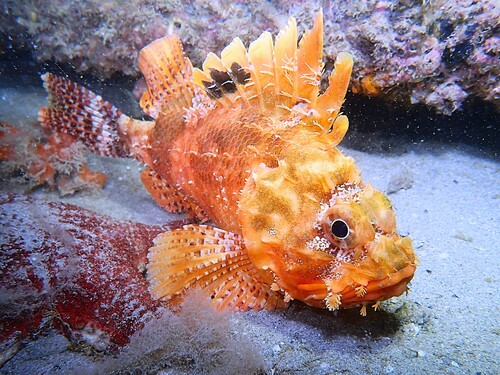
Description: Scorpaena guttata, also known as the California scorpionfish, reaches a maximum length of 43 to 47 cm (17 to 19 inches).
Coloration
It has a reddish brown body covered in many brown and black spots, with denser spotting on its fins.
Morphology & Resting Habit
Its head is covered in spines, it lacks a swim bladder, and it spends most of its time resting on the ocean floor.
Native Range
Distribution and habitat: This species is native to the eastern Pacific Ocean.
Geographic Distribution
Its main range extends from Santa Cruz in central California south along the coast of Baja California to Todos Santos, Baja California Sur. A small isolated population is also reported to live in the northern Sea of Cortez.
Depth Range
It is a demersal marine fish that can be found at ocean depths as great as 183 metres (600 ft), though it most often occurs in shallower water up to roughly 30 metres (98 ft) deep.
Habitat Type
It lives along rocky bottoms just offshore, in bays, and inside underwater caves.
Movement Patterns
This species does not stay in a fixed permanent territory. Mark and recapture experiments have recorded individuals traveling distances up to 200 kilometres (120 mi); one individual traveled from near Santa Cruz Island in the Channel Islands to Long Beach over approximately 14 months, and another individual traveled at an average rate of around 2.2 kilometres (1.4 mi) per day.
Known Parasites
Ecology: Scorpaena guttata acts as a host for multiple parasite species, including the copepods Bomolochus spinulus, Lepeophtheirus rotundipes, Naobranchia scorpaenae, Pseudodiocus scorpaenus, Hamaticolax spinulus, and Chondracanthus gracilis.
Octopus Interactions
One of its main predators is the California two-spot octopus (Octopus bimaculatus), which is rarely injured by the fish's spines thanks to its soft, flexible flesh. Scorpaena guttata will also prey on small California two-spot octopuses in turn.
Venom Source
Toxicity: Like many other scorpionfish, Scorpaena guttata has venom produced in glands located along its spines.
Human Exposure Risk
It has historically been called "one of the most noxious marine animals in California waters", and its spines have caused many injuries to humans. Fishermen are most often hurt when removing the fish from a hook; when pulled out of the water, the fish flares the spines on its fins and gill covers, making it difficult to handle safely.
Sting Symptom Overview
The sharp spines themselves can puncture skin, and the venom introduces additional painful and systemic symptoms. The effects of a sting are described as feeling very similar to those of a rattlesnake bite.
Recorded Sting Symptoms
One recorded case of a finger prick from a spine caused severe throbbing pain, cyanosis of the affected finger, followed by swelling, hardening, warmth, redness, and then numbness in the digit. Pain spread up the arm to the axilla, which developed painful masses. Systemic symptoms included nausea, faintness, and cool, clammy, pale skin.
Sting Case Outcomes
The victim fully recovered within two weeks. Another victim developed pericarditis after being envenomated.
Venom Delivery Mechanism
Each spine of this fish has two longitudinal grooves filled with epithelial tissue that holds venom-secreting glands, and the entire spine is covered by a thin outer membrane sheath. When the spine penetrates a victim, the membrane sheath is pushed back, which helps inject venom into the wound.
Venom Physiological Effects
Lab studies confirm this venom is cardiotoxic, causing fluctuations in blood pressure and EKG changes including ventricular tachycardia and bundle branch block.