About Sciurus vulgaris Linnaeus, 1758
Taxonomy and Size Measurements
The Eurasian red squirrel, Sciurus vulgaris Linnaeus 1758, has a typical head-and-body length of 19 to 23 cm (7.5 to 9.1 in), a tail length of 15 to 20 cm (5.9 to 7.9 in), and a body mass of 250 to 340 g (8.8 to 12.0 oz). Males and females are the same size.
Tail Function
The species’ long tail helps it balance and steer when jumping between trees or running along branches, and may help keep the squirrel warm while it sleeps.
Coat Color Variation
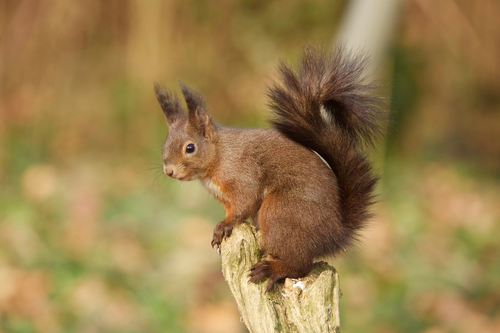
The red squirrel’s coat colour varies by time of year and location, with multiple colour morphs ranging from black to red. Red coats are most common in Great Britain; across other parts of Europe and Asia, multiple different coat colours coexist within populations, similar to human hair colour variation.
Underside Coloration
The underside of the red squirrel is always white-cream in colour.
Coat Shedding Pattern
This species sheds its coat twice a year: between August and November, it replaces its thinner summer coat with a thicker, darker winter coat that has noticeably larger ear-tufts, a prominent distinguishing feature of the species.
Distinction from Grey Squirrel
Lighter, redder overall coat colour, adult ear-tufts, and smaller size distinguish the red squirrel from the eastern grey squirrel.
Northern Habitat Preference
Red squirrels occupy boreal coniferous woods in northern Europe and Siberia, where they prefer Scots pine, Norway spruce, and Siberian pine.
Southern European Habitat
In western and southern Europe, they live in broad-leaved woods, where a mix of tree and shrub species provides a more reliable year-round food source.
Interspecific Competition Impact
In most of the British Isles and Italy, broad-leaved woodlands are now less suitable for red squirrels due to the superior competitive feeding strategy of introduced eastern grey squirrels.
Population Decline Drivers
Red squirrel populations have decreased in recent years in Great Britain, Ireland, and Italy, a decline associated with the human introduction of the eastern grey squirrel (Sciurus carolinensis) from North America.
Scottish Population Status
However, the Scottish red squirrel population is stabilising thanks to conservation efforts.
General Habitat Range
The red squirrel inhabits both coniferous forest and temperate broadleaf woodlands.
Drey Structure and Lining
It builds a nest called a drey from twigs in a branch fork, forming a domed structure around 25–30 cm (9.8–11.8 in) in diameter, which it lines with moss, leaves, grass, and bark.
Alternative Nesting Sites
It also uses tree hollows and abandoned woodpecker holes for nesting.
Solitary Feeding Behavior
The red squirrel is a solitary animal that is shy and reluctant to share food with other individuals.
Winter Drey Sharing
Outside of the breeding season, especially in winter, multiple red squirrels may share a drey to stay warm.
Social Hierarchy Structure
Its social organization is structured around dominance hierarchies within and between the sexes.
Home Range Variation
While males are not inherently dominant over females, dominant animals tend to be larger and older than subordinate individuals, and dominant males tend to have larger home ranges than subordinate males or females.
Primary Diet Components
The red squirrel eats mostly tree seeds, and will neatly strip conifer cones to access the seeds inside. Its diet also includes fungi, nuts (especially hazelnuts, as well as beech, chestnuts, and acorns), berries, vegetables, garden flowers, tree sap, and young shoots.
Rare Prey Items
More rarely, red squirrels may eat bird eggs or nestlings; a Swedish study examining 600 red squirrel stomach contents found only 4 contained remnants of birds or eggs.
Food Caching Behavior
Red squirrels store excess food in hidden caches called middens, either buried in the ground or tucked into nooks or holes in trees, to eat later when food is scarce.
Spatial Memory for Caches
While red squirrels remember the locations of their caches at a rate better than chance, their spatial memory is substantially less accurate and durable than that of grey squirrels.
Foraging Time Allocation
Between 60% and 80% of a red squirrel’s active period may be spent foraging and feeding.
Activity Pattern
The red squirrel follows a diurnal activity pattern.
Summer Midday Rest
During the summer, it often rests in its nest around midday to avoid heat and increased visibility to predatory birds, which are a danger during these hours.
Winter Activity Adaptations
In winter, this mid-day rest is usually much shorter or absent entirely, though harsh weather can cause the squirrel to stay in its nest for multiple days at a time.
Feeding Range Overlap
Red squirrels do not claim exclusive territories, and individual feeding areas overlap considerably.
Mating Seasons
Mating occurs in two periods: late winter between February and March, and summer between June and July.
Litter Characteristics
A single female can produce up to two litters per year, with each litter averaging three young, called kits. Gestation lasts approximately 38 to 39 days.
Neonatal Traits
Young red squirrels are cared for exclusively by their mother, and are born helpless, blind, and deaf, weighing between 10 and 15 g.
Juvenile Development Milestones
Their bodies are covered in hair by 21 days old, their eyes and ears open after three to four weeks, and all their teeth have developed by 42 days.
Weaning Timeline
Juvenile red squirrels can eat solid food around 40 days after birth, and can leave the nest on their own to find food from this point, but still suckle from their mother until weaning occurs at 8 to 10 weeks.
Mating Detection Behavior
During mating, males detect oestrous females by an odour the females produce.
Mating Chase Behavior
There is no courtship behaviour, but a male will chase a female for up to an hour before mating. Usually, multiple males will chase a single female until the dominant male (generally the largest in the group) mates with the female.
Mating System
Both males and females mate multiple times with many different partners.
Female Reproductive Condition
Females must reach a minimum body mass before they enter oestrus, and heavier females produce more young on average.
Breeding Variability
Breeding may be delayed if food is scarce. Typically, a female produces her first litter during her second year of life.