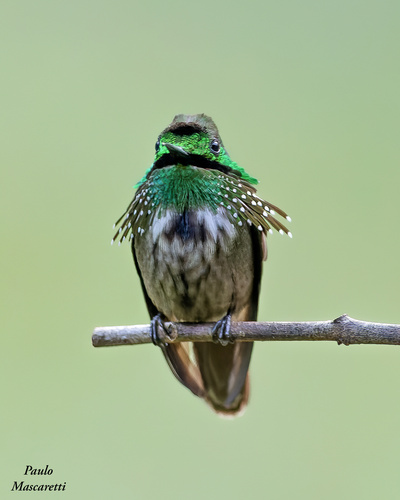
About Sappho sparganurus (Shaw, 1812)
Common Name and Taxonomy
This species, Sappho sparganurus (Shaw, 1812), is commonly known as the red-tailed comet.
Male Length
Males of the species are 19 to 20 cm (7.5 to 7.9 in) long, which includes their 7 to 10 cm (2.8 to 3.9 in) tail.
Female Length
Females measure 12 to 14 cm (4.7 to 5.5 in) in length.
Species Weight
The full species has an approximate weight of 4 to 6.5 g (0.14 to 0.23 oz).
Nominate Male Head and Gorget
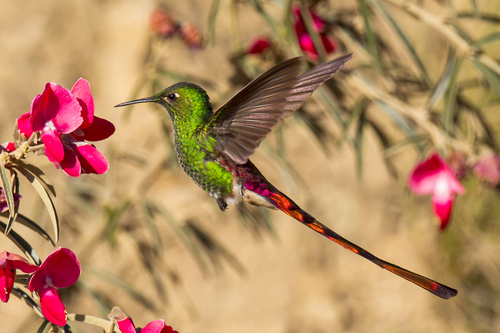
Adult males of the nominate subspecies have a shining green head with a golden green or emerald green gorget.
Nominate Male Body Plumage
Their back and rump are reddish purple, and their underparts are mostly green with buffy undertail coverts.
Nominate Male Tail
They have a long, deeply forked tail; the upper surface of the tail appears reddish purple to green depending on the angle of incoming light, and the tail feathers have wide velvety black to dusky purple tips.
Female Plumage Overview
Adult females are overall duller in color than males, and have a shorter tail.
Female Upperparts
Their head and back are shining green, and their rump is reddish purple.
Female Underparts
Their throat and underparts are pale buff, with small green speckles on the throat, breast, and upper belly.
Female Tail Features
The outer tail feathers of females have white or buffy white outer webs.
Juvenile Plumage
Juveniles resemble adult females, but have dull bronzy green upperparts with a slightly coppery rump, and more white on their outer tail feathers.
S. s. sapho Plumage Differences
Subspecies S. s. sapho is paler than the nominate subspecies, and is golden orange in the areas where the nominate subspecies is reddish purple.
Shared Morphological Traits
Both sexes of both subspecies have a reddish brown iris, a black bill, and black legs and feet.
Range Disagreement Overview
Sources do not agree on the full range of the red-tailed comet.
SACC Range Classification
According to the South American Classification Committee of the American Ornithological Society, the species is found only in Argentina and Brazil.
Alternative Range Reports
Other taxonomic systems and authors add Chile, possibly Peru but not Chile, both Chile and Peru, or Peru and possibly Chile to its documented range.
Subspecies Distribution Disagreement
Sources also disagree on the distributions of the two recognized subspecies.
Nominate Subspecies Distribution Reports
The nominate subspecies has been variously reported as occurring in northern Bolivia and possibly extreme southern Peru; in northern and central Bolivia; and in northern and central Bolivia, as an accidental in southern Peru.
S. s. sapho Distribution Reports
Subspecies S. s. sapho has been variously placed in central Bolivia and northern and western Argentina; in southern Bolivia, northern and western Argentina, and east-central Chile; and from southern Bolivia to western Argentina and northern Chile.
Primary Habitat
The red-tailed comet inhabits arid montane scrublands on the eastern slope of the Andes and in valleys within the Andes.
Habitat Characteristics
Its typical habitat has a landscape characterized by scattered trees, a bushy understorey, and dense tangles in ravines.
Additional Habitat
It also occurs in Polylepis woodlands.
Elevation Range
Most of its range falls between 1,500 and 4,200 m (4,900 and 13,800 ft) in elevation, though it has been reported as low as 400 m (1,300 ft).