About Lophornis chalybeus (Temminck, 1821)
Taxonomy and Size
The festive coquette, Lophornis chalybeus (Temminck, 1821), measures 7.5 to 9.1 cm (3.0 to 3.6 in) in length, and adult individuals weigh approximately 3 g (0.11 oz).
Bill Structure
Both males and females have a short, straight, black bill.
General Plumage
Their upperparts are bronzy green, with a pale band across the rump; their lower rump and undertail coverts are purplish bronze, and their tail is purplish copper with pale tips on the outer feathers.
Adult Male Head Plumage
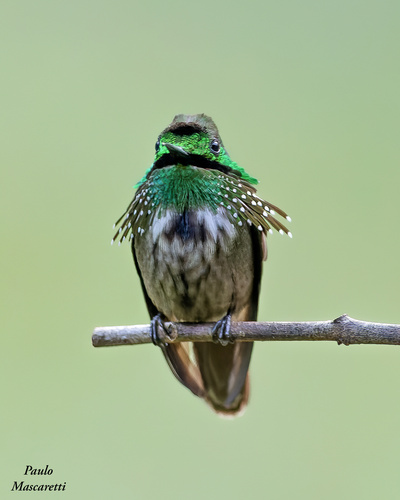
Adult males have an iridescent green forehead, surrounded by a band of stiff black feathers. They have green cheek tufts tipped with white, and a glittering green ruff with white tips around the bill and chin.
Adult Male Body Plumage
Their breast is whitish, streaked with black, and their belly is grayish brown with a blackish stripe running down the center.
Adult Female Head Plumage
The adult female has blackish cheeks, lacks the male's tufts, but has a white "moustache".
Adult Female Body Plumage
Its chin is pale buff with a dark spot in the center, and the rest of its underparts are brownish with whitish scaling.
Juvenile Appearance
Juvenile festive coquettes are similar in appearance to adult females.
Confirmed Distribution
The festive coquette is native to southeastern Brazil, where it occurs from Espírito Santo southward into Santa Catarina.
Unconfirmed Distribution
While there have been records of the species in northeastern Argentina, these have not been confirmed, so the South American Classification Committee of the American Ornithological Society (SACC) lists the species as hypothetical for Argentina.
Habitat and Elevation Range
It inhabits humid primary forest, humid secondary forest, and cerrado, and can be found at elevations ranging from sea level up to 1,000 m (3,300 ft).