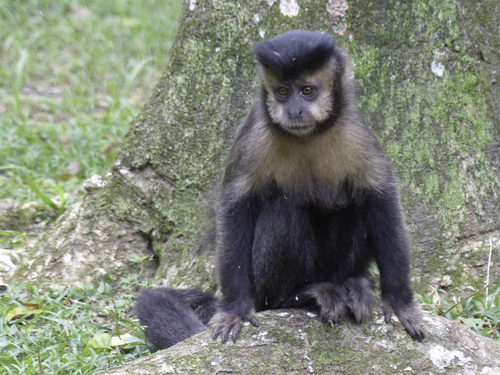
About Sapajus nigritus (Goldfuss, 1809)
Scientific and Common Names
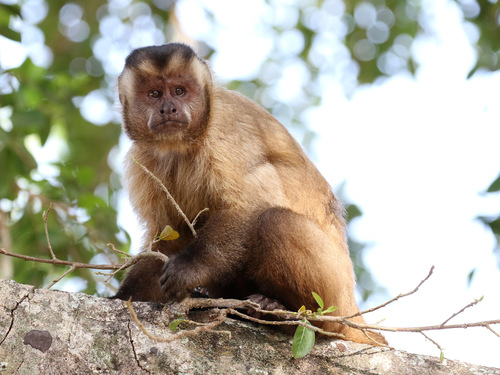
The black capuchin, scientifically named Sapajus nigritus, is also commonly called the black-horned capuchin. It is a capuchin monkey native to the Atlantic Forest of southeastern Brazil and far northeastern Argentina.
Taxonomic History
Historically, this species was classified as a subspecies of the tufted capuchin.
Range
The black capuchin’s range covers the Atlantic region of northeastern Argentina and southeastern Brazil, and its habitat overlaps with the ranges of other capuchin species.
Habitat and Movement
It is considered an arboreal species that primarily dwells in the tree canopy, but it will also descend to the forest floor to forage, where insects and nuts are most abundant.
Female Mating Preference
When choosing a sexual partner, female black capuchins strongly prefer the group’s alpha male. One study found that the alpha male is the target of three-quarters of all female sexual advances, and the study found no evidence that the alpha male coerces females into mating with him.
Mating Initiation Signals
To initiate mating, females use a wide range of both auditory and visual signals at different stages of the mating process. Some evidence suggests these signals help encourage copulation to occur at the time that is most opportune for procreation; for example, visual signals increase in frequency as ovulation approaches.
Mating Call Variation
At least seven distinct calls are used specifically for mating-related communication, though no evidence shows that call type correlates with ovulation stage or fertility. Calls do, however, differ between the pre-copulation and post-copulation periods.
Post-Copulation Call Function
Calls vocalized after mating may function to confirm the chosen male’s paternity to him by making the mating public knowledge. This encourages the male to guard the female and her future offspring from competing males and infanticide.
Male Postcoital Courtship Function
In this context, male postcoital courtship may serve the purpose of mate protection.
Offspring Protection Strategies
To achieve this same goal of protecting potential offspring, a female that may be impregnated will use visual signals to confirm the alpha male’s status as her mate, while using vocalizations to confuse other males about the true paternity of her offspring, which discourages them from acting aggressively toward her or the offspring.