About Salvelinus namaycush (Walbaum, 1792)
Body Shape and Fin Structure
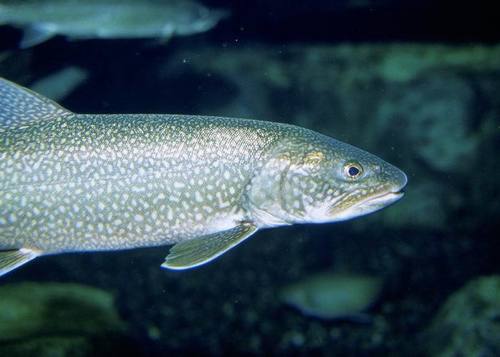
Lake trout (Salvelinus namaycush) have a typical body shape for the Salmonidae family: they are elongated, have one dorsal fin and one adipose fin, and have no spines on any of their fins.
Baseline Body Coloration
Their body color is a uniform olive-grey, which is darker along the back and white on the belly. The entire body is covered in light beige or white spots.
Baseline Fin Coloration
Their fins are yellowish, and may have white tips.
Spawning Season Coloration
During the spawning season, their bellies turn a more yellow-orange color, their fins develop a red shade, and their white fin edges become more prominent.
Dentition
They have small but sharp teeth that are more visible during non-spawning periods than the teeth of other trout species.
Species Size Status
Lake trout are the largest species of char.
All-Tackle Record Specimen
The all-tackle record specimen weighed almost 102 pounds (46 kg), measured 50 inches (130 cm) in length, and was caught using a gillnet.
Common Size and Weight
Fish weighing 15 to 40 pounds (6.8 to 18.1 kg) are not uncommon, and the average length of a lake trout is 24 to 36 inches (61 to 91 cm).
Rod and Reel Record Specimen
According to the IGFA, the largest lake trout caught on rod and reel weighed 72 pounds (33 kg), measured 59 inches (150 cm), and was caught at Great Bear Lake in 1995.
Tahoe Region Size
In the Tahoe region, lake trout do not grow larger than 36 pounds (16 kg), but average over 10 pounds (4.5 kg).
Native Distribution Range
From a zoogeographical perspective, lake trout have a relatively narrow native distribution. They are native only to northern North America, primarily Canada, and also live in Alaska, as well as parts of the Northeastern United States.
Global Introductions
Lake trout have been widely introduced to non-native waters across North America and to many other regions of the world, mainly Europe, along with South America and parts of Asia.
Yellowstone National Park Introductions
While lake trout were legally introduced to Shoshone Lake, Lewis Lake, and Heart Lake in Yellowstone National Park in the 1890s, they were illegally or accidentally introduced to Yellowstone Lake in the 1980s, where they are now classified as invasive.
Tahoe Region Introductions
They have also been famously introduced to water bodies in the Tahoe region, including Lake Tahoe and Donner Lake.