About Prosopium cylindraceum (Pennant, 1784)
Common and Taxonomic Classification
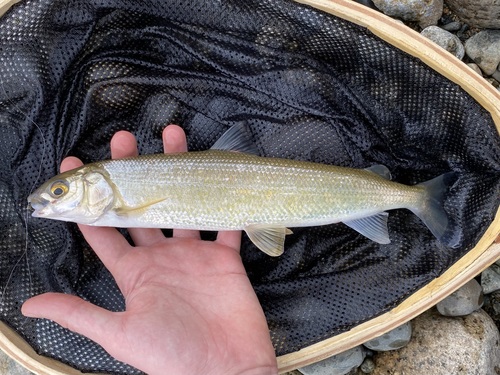
Prosopium cylindraceum, commonly called the round whitefish, is a member of the salmon family. Compared to other members of the salmon family, this species and its subfamily have larger scales, a smaller mouth, weak or no teeth, and other distinct internal characteristics.
Body Shape
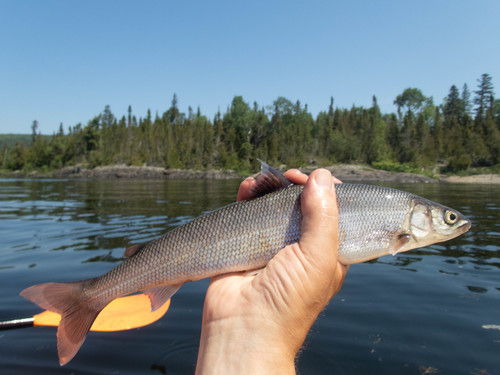
As its scientific epithet cylindraceum suggests, the round whitefish has a cylindrical body, and is considered a deep-bodied fish.
Coloration
It is mostly silver in color, with clear regional variations on the body: its back has a greenish tinge, with scales ranging from sepia brown to bronze and edged in black; its lower fins are various shades of amber, and its adipose fin is normally marked with brown spots.
Scale Count
The round whitefish has between 42 and 46 scales around its body, 22 to 24 scales around its caudal peduncle, and 83 to 96 scales in its lateral line.
Internal Anatomical Features
In addition, this species has 87 to 117 pyloric caeca, 59 to 63 vertebrae, and fewer than 20 gill rakers.
Distinguishing Nostril Feature
The round whitefish differs from other whitefish by having one flap between the nostril openings, instead of two.
Size and Growth Rate
It can grow up to 50 centimetres (20 in) in length, and typically grows 55 to 65 millimetres (2.2 to 2.6 in) annually. Most of its growth takes place in its first five years of life, and round whitefish can live up to 12 years.
General Habitat Types
Round whitefish are found in cold freshwaters of Arctic seas, post-glacial lakes, rivers, and brackish waters.
Global Distribution and Depth Range
This wide-ranging species inhabits the northern waters of North America to the northeastern waters of Asia, normally at depths of 55 to over 213 m (180 to over 700 ft).
Asian Distribution
In Asia, they commonly occur from the Siberian Yenisei River to Kamchatka and the Bering Sea.
North American Distribution
The North American range of the round whitefish includes all Great Lakes except Lake Erie, areas of the Arctic Ocean, Hudson Bay, waterways in northern Canadian provinces, Arctic brackish waters, and all of Alaska.
Brackish Water Tolerance
Although they are a freshwater species, round whitefish can be found in areas of the Arctic Ocean with very low salinity, produced by the large volume of rivers and waterways that empty into the Arctic Sea. This explains their wide distribution across northern waters.
Spawning Migration Behavior
Round whitefish make regular migrations to and from freshwater tributaries, where spawning occurs.
Spawning Site Characteristics
Spawning sites are covered with various-sized pebbles, and sit below shoreline currents at roughly 1 to 1.5 metres (3.5 to 5 ft) deep. Even at this depth, an underwater current with a velocity of 0.5 to 1 m/s (1.6 to 3.3 ft/s) disperses some of the deposited eggs downstream into the tributary system.
Egg Characteristics
Fertilized eggs are 3.1 to 3.25 mm (0.12 to 0.13 in) in diameter, and settle in spaces between rocks as well as in the ice crystals of the slushy tributary floor.
Sexual Dimorphism
Sexual dimorphism is subtle in round whitefish compared to other species in the salmon family. During spawning, males develop distinct pearl organs along the sides of their bodies and undergo changes in coloration: their pelvic, pectoral, and anal fins, as well as their belly, become a shade ranging from yellow-orange to red.
Spawning Timing
Round whitefish are fall spawners, laying their eggs between early October and late November, when the water temperature is at or below 2.5 °C (36.5 °F). The spawning migration begins in August, although fish maturing for the first time tend to start migrating as early as June.
Spawning Frequency and Maturity Age
Round whitefish normally experience their first spawning at age seven. This species does not spawn annually, but it is common for first-time spawners to spawn the following year.
Post-Maturity Growth Changes
After sexually mature round whitefish reach the tributary system, overall growth slows, and annual growth increments decrease from 55–65 mm (2.2–2.6 in) to 40–45 mm (1.6–1.8 in) due to reduced food intake.
Fisheries Relevance
Round whitefish is not a primary target of subsistence or sport fisheries. Relatively low numbers of round whitefish are caught, and currently there are no fisheries that specifically target this species.
Human Impact Research
Human activity near round whitefish habitats has some impact on these fish. Various studies have been carried out near developing projects to understand if and how nearshore developments such as mining influence fish populations.
IUCN Population Status
According to the IUCN Red List species assessment, the global round whitefish population is currently estimated to be either stable or gradually declining.
Local Human-Caused Stressors
In several studies, a decrease in round whitefish food sources, as well as a decrease in water quality, has been observed linked to human activity.
Global Warming Threat
On a broader scale, human activity drives the ongoing phenomenon of global warming. While changes to round whitefish populations have been minimal compared to other aquatic species so far, this impact could grow into a larger problem if global warming continues.
Temperature Sensitivity
Round whitefish live and spawn in cold waters, so if water temperatures continue to rise as a result of global climate change, this species may be negatively affected. If these impacts become sufficiently detrimental, broader conservation measures may need to be implemented for the round whitefish.
Local Threat Overview
On a local scale, both biotic and abiotic factors can threaten round whitefish and even lead to local extirpation.
Predation Threats
Predation from native and introduced species such as yellow perch (Perca flavescens), smallmouth bass (Micropterus dolomieu) and rainbow smelt (Osmerus mordax) is harmful to existing populations and may prevent reintroductions of round whitefish. Competition for food resources during younger life stages with juvenile smelt can also limit populations.
Water Quality Threats
Acid rain has been cited as contributing to round whitefish decline in New York. Siltation, which damages spawning habitat, and chloride pollution from road salt runoff may also impact round whitefish in developed areas.