About Prosopium williamsoni (Girard, 1856)
Nomenclature
This species has the scientific name Prosopium williamsoni (Girard, 1856), and is commonly called the mountain whitefish.
Distinguishing Morphological Features
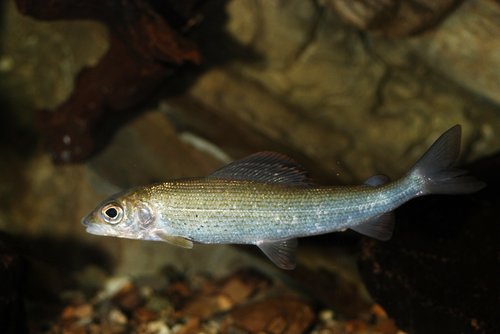
Its body shape is superficially similar to that of cyprinids, but it can be distinguished by the presence of both an adipose fin and an axillary process, which are features of salmonids.
Body Shape and Coloration
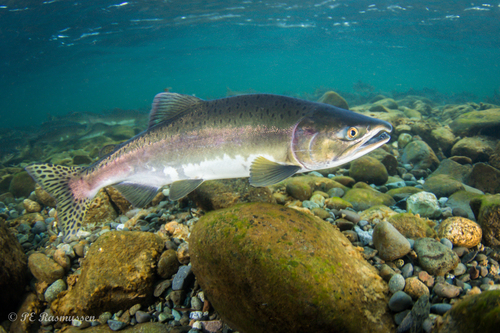
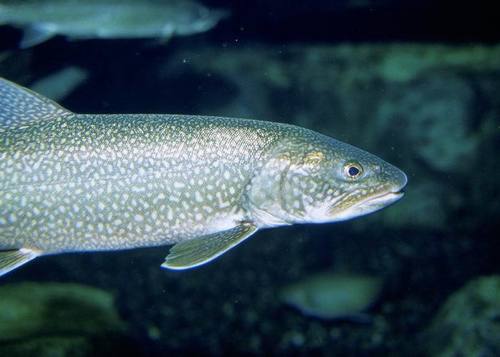
Its body is slender and nearly cylindrical in cross section; it is generally silver overall, with a dark dusky olive-green shade on its dorsal side.
Scale Characteristics
Its scales have pigmented borders, which are particularly clearly defined on the posterior end of the body.
Tail Structure
Mountain whitefish have a forked homocercal tail.
Head and Mouth Structure
They have a short head with a small mouth positioned underneath the snout.
Fin Ray Counts
Their short dorsal fin has 12–13 fin rays, their anal fin has 11–13 rays, their pelvic fins have 10–12 rays each, and their pectoral fins have 14–18 rays each.
Maximum Size and Weight
Recorded maximum size for the species is up to 70 centimeters (28 inches) in total length, with a maximum recorded weight of 2.9 kilograms (6.4 lb).
Habitat Preferences
Mountain whitefish are most commonly found in mountain streams and lakes.
Water and Microhabitat Preferences
They prefer clear, cold water and large deep pools that are at least one meter deep; the population living in Lake Tahoe occupies water just above the lake bottom in deeper areas of the lake.
Geographic Distribution Range
This species occurs throughout the western half of North America.
Specific Distribution Localities
It ranges as far north as the Mackenzie River in Canada and the drainages of Hudson Bay, and is also found in the Columbia River, upper Missouri River, upper Colorado River, Adirondack Lakes of New York, and Lake Champlain.