About Hippotragus equinus (É.Geoffroy Saint-Hilaire, 1803)
Physical description
Size
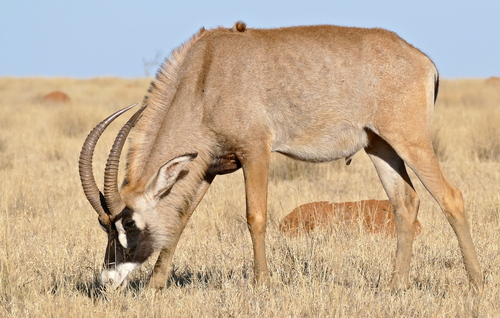
The roan antelope is a large antelope with a horse-like build. It is the largest antelope in the genus Hippotragus, and one of the largest antelope species in the world. On average, only elands, bongos and large male greater kudus exceed roan antelopes in weight. Roan antelopes stand 135–160 centimetres (53–63 in) at the shoulder, weigh 230–320 kilograms (510–710 pounds), and typically have a head-and-body length between 235 and 285 centimetres (93 and 112 inches). Their dark tail ends in a black tuft and measures up to 54 cm (21 in).
Characteristic features
Characteristic features of the roan antelope include a short, erect mane of grayish brown hair that extends from the back of the neck along the midline of the back up to the withers; white patches around the eyes and mouth on an otherwise black face; and long, narrow ears with 3–5 cm (1.2–2.0 in) long tufts. Their horns are ringed and arched backwards; male horns can reach 100 cm (39 in) long, while female horns are slightly shorter. They have long legs supported by large hooves. Their short, smooth coat ranges from brown to amber. Their ventral parts are yellow to white, while their neck and manes are gray to black.
Similar species
Roan antelopes are somewhat similar in appearance to sable antelopes, and can be confused with them where their ranges overlap. Male sable antelopes are notably darker than roan antelopes, being brownish-black rather than dark brown.
Habitat and behavior
Habitat
Roan antelopes inhabit woodland, grassland, and savannah, mainly within the tropical and subtropical grasslands, savannas, and shrublands biome. This biome ranges from forest with a grassy understory (such as the central Zambezian Miombo woodlands) to open grasslands dotted with few trees.
Feeding
Roan antelopes feed on mid-length grasses here.
Social behavior
They live in small groups, forming harem groups of 5 to 15 animals with one dominant male. Males commonly fight among themselves for herd dominance, brandishing their horns while both animals are on their knees.
Hybridisation
Roan antelopes are known to hybridise with sable antelopes where the two species' distributions overlap. This hybridisation occurred because wartime poaching depleted populations of both species.