About Rollandia rolland (Quoy & Gaimard, 1824)
Nomenclature
This species, the white-tufted grebe, has the scientific name Rollandia rolland (Quoy & Gaimard, 1824).
Size and Sexual Dimorphism
Males and females look alike, and their total length ranges from 24 to 36 cm (9.4–14.2 in). Lower and medium length measurements are typical for populations on the South American mainland, while upper measurements are typical for the Falkland population.
Breeding Plumage Head Features
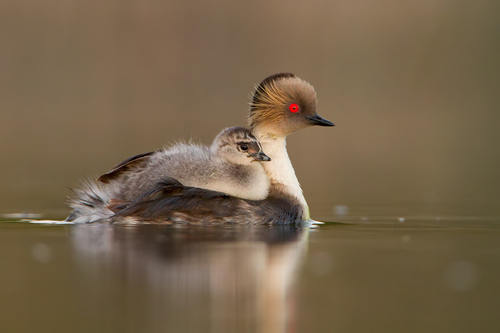
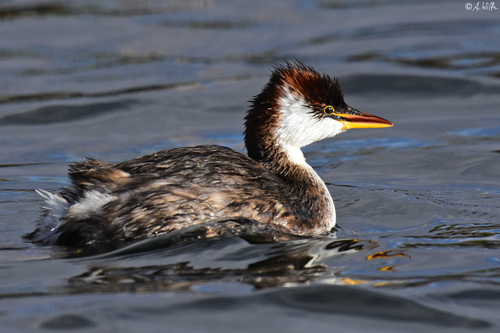
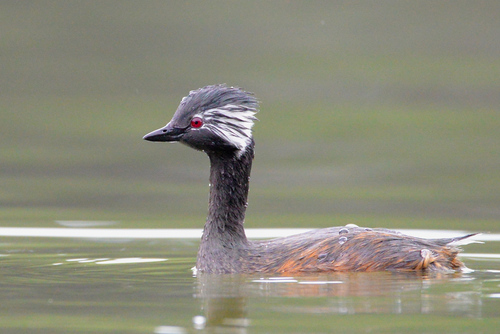
In breeding plumage, adult white-tufted grebes have a prominent black crest on the back of the head. They have a large white tuft of feathers around the ear; the rest of the head, neck, and back are black with a slight greenish sheen, and the feathers of the mantle and back have narrow brown borders.
Breeding Plumage Body and Wing Features
The underparts are dull reddish-brown, often mottled with brown or grey. Secondary wing feathers are white, pale grey, or have white tips.
Breeding Plumage Soft Parts
The eye is red, the beak is black, and the legs are grey or olive-brown.
Non-breeding Plumage Head and Upperparts
In non-breeding plumage, adult white-tufted grebes are dark brown instead of black. Their crest becomes inconspicuous, the sides of the head and throat are white, and they retain their white wing patches.
Non-breeding Plumage Underparts
The neck and chest are buff, and this color gradually pales to white on the belly.
Immature Plumage
Immature birds resemble non-breeding adults, but have brown streaking on their throats and the sides of their necks.
Distribution Elevation Range
The white-tufted grebe is distributed across southern and western South America, where it occurs from lowlands up to 4,500 m (14,800 ft) above sea level.
Country-level Distribution
Its range includes south-eastern Brazil, Uruguay, Paraguay, Bolivia, Chile, Peru, Argentina, and the Falkland Islands. It occurs as a vagrant in the South Sandwich Islands and South Georgia.
Freshwater Habitat
Its typical habitat is lakes, marshy ponds, ditches, and slow-moving rivers and streams.
Post-breeding Movement
After the breeding season, birds living in southernmost South America form flocks and migrate north along the coast, where they are often seen in bays and other sheltered marine locations.