About Rhombomys opimus (Lichtenstein, 1823)
Common Name and Size Classification
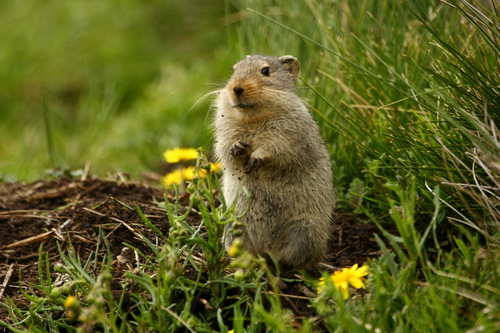
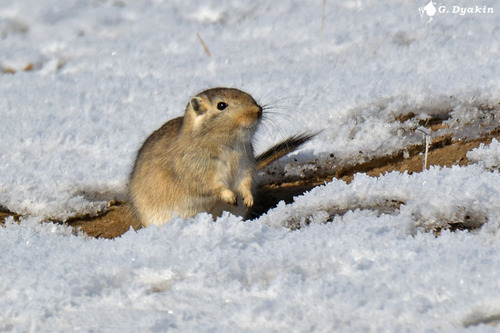
Rhombomys opimus, commonly called the great gerbil, is the largest species of gerbil.
Head and Body Length
Great gerbils have a head and body length ranging from 15 to 20 cm, which is 6 to 8 inches.
Skull Trait
Their skulls have a distinct trait: each incisor has two grooves.
Claw Adaptation
They have large front claws adapted for burrowing.
Habitat Type
Great gerbils live in arid habitats, most often sandy or clay deserts.
Geographic Range
Their range includes Turkmenistan, Kazakhstan, Mongolia, China, Pakistan, Afghanistan, and Iran.
Social Structure
Great gerbils live in family groups, with one burrow occupied per family.
Burrow Structure
Their burrows can be quite extensive, with separate chambers built for nests and food storage.
Winter Activity
Great gerbils spend much more time in their burrows during winter, but they do not hibernate.
Activity Pattern and Diet
They are mainly diurnal, and their diet consists mostly of vegetable matter.
Social Behavior and Lifespan
They are often colonial, and their typical lifespan is 2 to 4 years.
Burrow Complex Identification
Complex great gerbil burrow systems have a distinct area of cleared soil, so these complexes can be seen and mapped from aerial photos and satellite images.
Burrow Status Assessment via Satellite
Satellite imagery can also be used to tell the difference between inhabited and abandoned great gerbil burrows.
Disease Reservoir Role
Great gerbils are known reservoirs for Yersinia pestis, the bacterium that causes plague, and Leishmania major, the parasite that causes zoonotic cutaneous leishmaniasis.
Human-Wildlife Conflict
They are also considered crop pests, and they have been linked to worsening erosion.