About Myotomys sloggetti (Thomas, 1902)
Overall Size
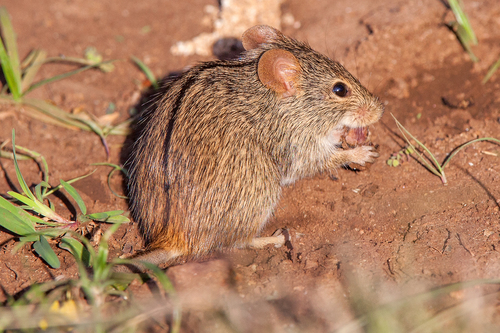
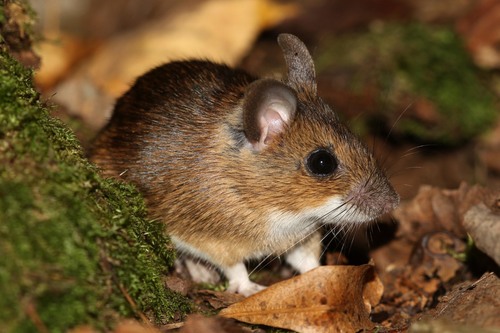
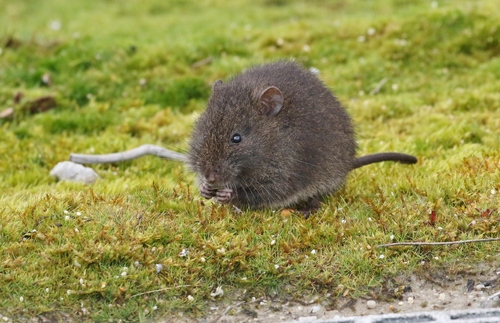
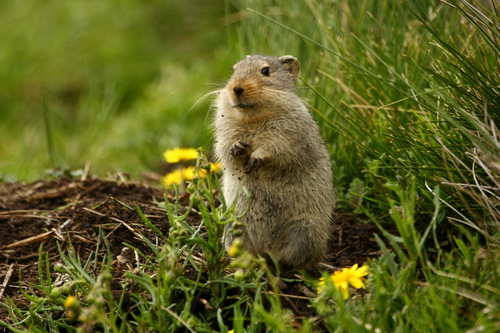
Myotomys sloggetti (Thomas, 1902), commonly called Sloggett's vlei rat, is a medium-sized rat species. It has thick, soft, fine fur, a large head, and a blunt snout.
Distinctive Markings
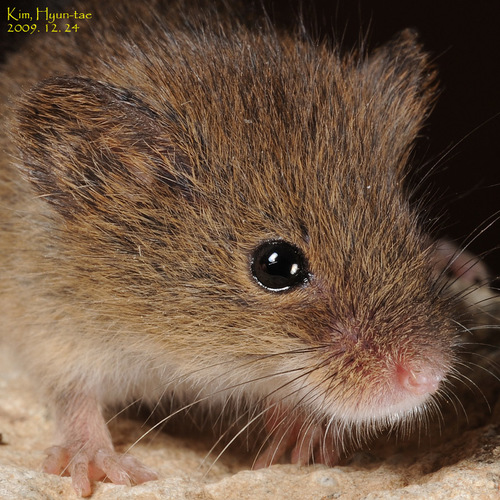
The patch of skin surrounding its whiskers is reddish brown, a trait that sets this species apart from other members of the genus Otomys. Its ears are small with dark edges.
Body Colour
The upper parts of its body are greyish buff, while its flanks are greyish brown, and its underparts are buffy white.
Tail Colour
The tail is short, measuring approximately half the length of the head and body combined, and is bicoloured: black on the upper side and buff on the lower side.
Sloggett's vlei rat is endemic to southern Africa, where it is found in southern Lesotho, South Africa's Eastern Cape, and the western regions of KwaZulu-Natal. It lives in rocky habitats and alpine grassland, both wet and dry, at altitudes over 2,000 meters (6,600 feet), most commonly above 2,600 meters (8,500 feet).
Habitat and Density
This rodent is common in suitable habitats, with observed densities of over 100 individuals per hectare. It lives in burrows, and emerges during the day to forage and bask in the sun on rocks. Its diet is made up of the leaves, flowers, and stems of green plants.
Winter Food Storage
In summer, it eats food where it is found, but in winter it mostly carries food back to its burrow to eat. Some food is also stored within the burrow, which forms a complex system of tunnels and chambers. Burrows are typically occupied by a pair or a family group, in which only one female breeds.
Burrow Life
Although the rats are territorial outside the burrow, they huddle together inside to retain warmth. They remain active year-round, but spend more time underground during winter. Burrows can have up to a dozen entrances, and the rats deposit faeces beside these entrances.
Breeding Season
Breeding occurs in late summer. Average litter size is 2.5 young, and the gestation period is around 38 days.
Winter Adaptations
The young have multiple adaptations to survive extreme winter cold: their body, ears, limbs, and tail are shorter than those of the southern African vlei rat (Otomys irroratus), which reduces heat loss, and they have a long lactation period that lets them stay underground until they reach a larger age.