About Rhacophorus rhodopus Liu & Hu, 1960
Species Introduction
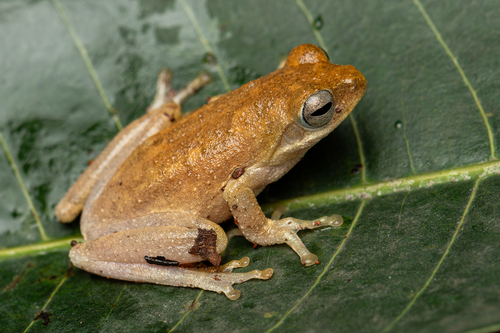
Rhacophorus rhodopus is a small tree frog species with a pointed snout.
Size
Adult body length ranges from about 31 to 55 mm (1.2 to 2.2 inches), and females are larger than males.
Dorsal Coloration (Living Specimens)
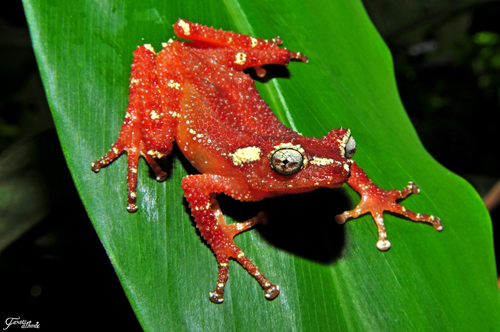
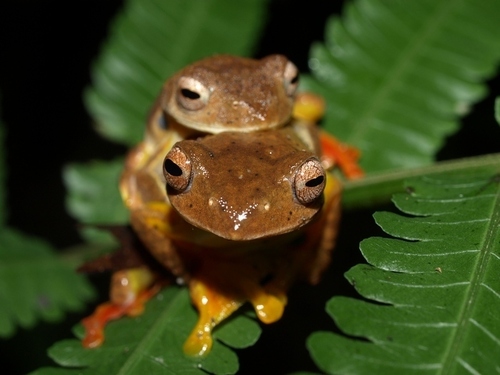
In living individuals, the back is reddish-brown, pinkish-brown, or yellowish-brown with no green hues; this color changes to purplish brown in preserved specimens.
Dorsal Pattern
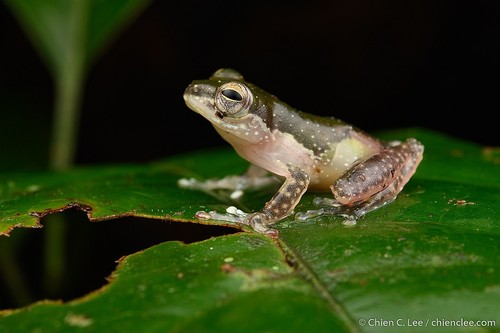
The entire back is covered in many darker spots, which usually form an X-shaped pattern behind the head, and sometimes form stripes across the lower back.
Additional Dorsal Markings
A small number of large white spots may also appear on the back.
Limb Coloration
Most or all of the hind legs and upper sides of the arms match the back's color, and dark bands are usually present across the upper surfaces of the arms and hind legs.
Ventral and Toe Coloration
The sides, belly, and toes are dark yellow, turning dark pink in preserved specimens.
Flank Markings
Almost always, there is a prominent large black spot on the flanks behind the arms.
Toe Webbing
The well-developed webbing on the toes is bright orange-red and has no spots.
Eye Color
The eyes are light brown.
Taxonomic Distinction from R. bipunctatus (Size)
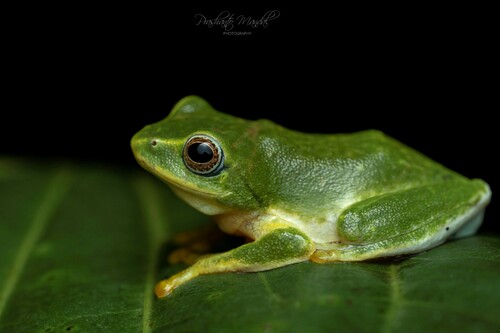
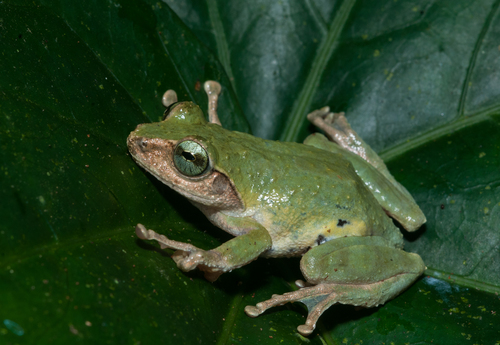
This species was long confused with Rhacophorus bipunctatus, and can be distinguished from it by its smaller overall size (R. bipunctatus adults measure 37–60 mm in body length), and by its spotted brown back that has no green or olive tones (R. bipunctatus has a bright green to brownish green back with no darker spotting).
Taxonomic Distinction from R. bipunctatus (Head Size)
When individuals are of similar size, R. bipunctatus has a much larger head than R. rhodopus.
Habitat
The natural habitats of R. rhodopus are subtropical or tropical moist lowland forests, subtropical or tropical moist montane forests, and intermittent freshwater marshes.
Altitudinal Range
It occurs from near sea level up to altitudes of at least 1,500 m (4,900 ft) above sea level.
Historical IUCN Status (Synonymized with R. bipunctatus)
R. rhodopus was previously considered synonymous with R. bipunctatus, so it was included in the IUCN status assessment for R. bipunctatus, which was assessed as a Species of Least Concern in 2004 due to its wide range.
Historical IUCN Status (R. namdaphaensis)
Rhacophorus namdaphaensis, a name that refers to the same frogs as R. rhodopus, was assessed as a Data Deficient species in 2004 due to uncertainty about the limits of its distribution.
Current Conservation Status
When R. rhodopus is accepted as a valid distinct species that includes R. namdaphaensis, it is classified as Least Concern, meaning it is not a threatened species.