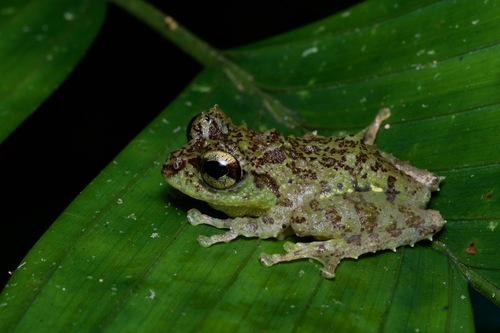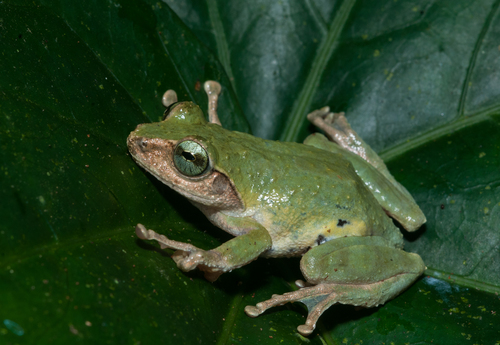
About Kurixalus berylliniris Wu, Huang, Tsai, Li, Jhang & Wu, 2016
Size
Adult male Kurixalus berylliniris measure 29–42 mm (1.1–1.7 in) in snout–vent length, while adult females measure 28–46 mm (1.1–1.8 in).
Body Shape
The species has a moderately slender, somewhat flattened overall body shape. Its head is wider than it is long.
Snout Morphology
The tip of the snout is pointed, and the snout appears obtuse when viewed from the side. The canthus rostralis is curved and prominent.
Tympanum Features
The tympanum is distinct, measuring about half the diameter of the eye, and a supratympanic fold is present.
Limb Structure
The limbs are slender. The tips of the fingers and toes are expanded into discs.
Webbing Characteristics
The fingers have slight webbing, while the toes are approximately half-webbed.
Dorsal Skin Texture
Dorsal skin is granular and covered in small tubercles.
Color Morph Types
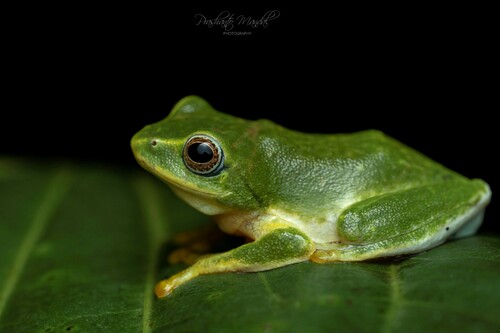
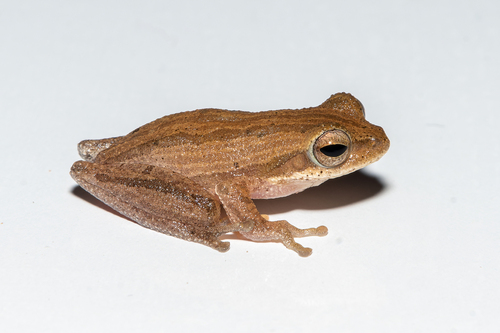
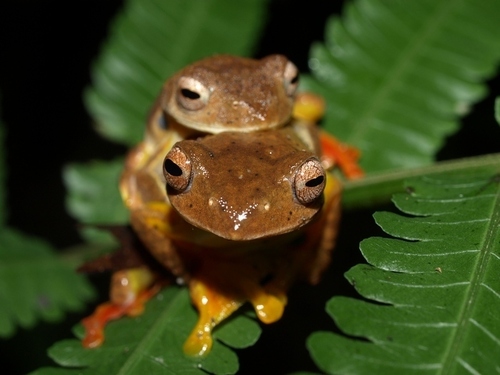
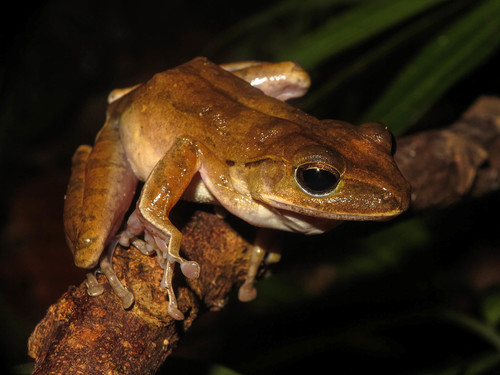
This species has two distinct color morphs: dark and light.
Dark Morph Coloration
The dark morph ranges from dark green to deep tan, marked with a black X-shaped blotch alongside other irregular blotches; its tympanum is light yellowish-brown with small dark spots.
Light Morph Coloration
The light morph is light emerald green, and its dorsal X-shaped pattern is obscured.
Venter Coloration
The venter is cream-colored, with tiny black spots scattered across the gular region.
Iris Coloration
The iris ranges from emerald to light green.
Distribution Range
This species is found in eastern Taiwan, south of central Hualien. It occurs on the eastern slopes of the Central Mountain Range and in the Coastal Mountain Range.
Habitat Parameters
Kurixalus berylliniris has been recorded in moist broad-leaf forests and forest edges, at elevations between 225 and 1,250 m (738–4,101 ft) above sea level.
Arboreal Habit
It is an arboreal species.
Breeding Habitat
Its eggs and tadpoles have been found in small water pools contained in decaying trunks of the tree fern Cyathea spinulosa.
Tadpole Diet
The tadpoles of this species are oophagous.
Threat Status
Specific threats to Kurixalus berylliniris have not been confirmed.
Potential Threats
While deforestation has generally slowed in Taiwan, loss of the tree holes that the species uses for breeding is a potential threat.
Protected Area Occurrence
This species is not known to occur in any protected area.