About Rhacophorus malabaricus Jerdon, 1870
Species Identification
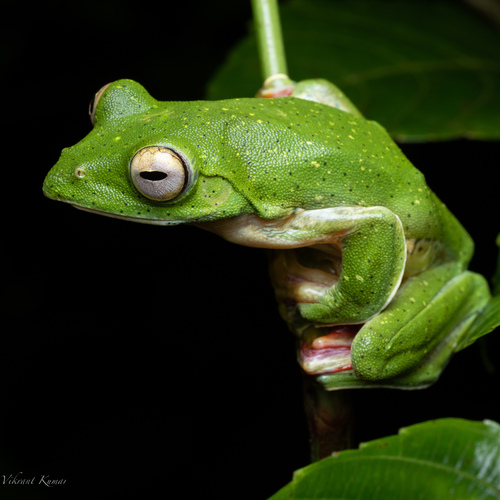
Rhacophorus malabaricus Jerdon, 1870, commonly known as the Malabar gliding frog, is one of the largest species of moss frogs, reaching a body length of around 10 cm (4 in). Males of this species are smaller than females.
Dorsal Skin & Coloration
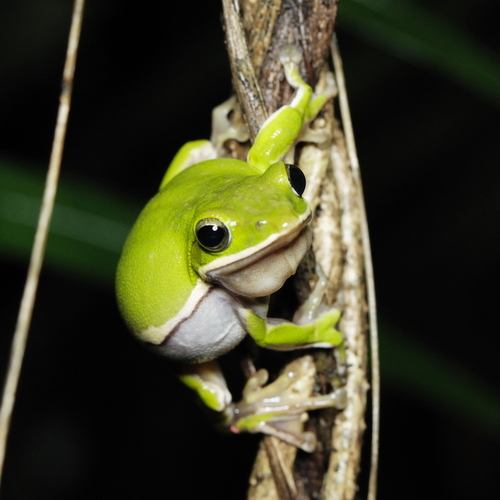
Its back has finely granulated skin and a uniform vivid green color without markings, a trait that distinguishes it from the closely similar species R. pseudomalabaricus. R. pseudomalabaricus has a black-marbled back and was long classified as part of Rhacophorus malabaricus.
Preserved Specimen Color Change
In preserved specimens, the back of Rhacophorus malabaricus turns purplish blue.
Ventral Skin & Coloration
The belly has coarser granulation, especially under the thighs, and is pale yellow.
Limb Skin Features
There are skin fringes between and along the frog’s long limbs, and a triangular skin extension at the heel.
Webbing Characteristics
The webbing between its fingers and toes is large and colored orange-red.
Vomerine Teeth Arrangement
Vomerine teeth are arranged in two straight or slightly oblique series that touch the inner front edge of the choanae.
Snout Morphology
The snout is rounded but not very wide, and is about as long as the diameter of the eye orbit.
Head Facial Features
The canthus rostralis is bluntly angled, and the loral region is concave. Nostrils are positioned closer to the tip of the snout than to the eyes.
Interorbital Space
The interorbital space is broader than the upper eyelid.
Tympanum Size
The tympanum diameter measures 60–70% of the eye diameter.
Digit & Tubercle Features
The disks on the fingers and toes are large, around the same size as the tympanum, and the subarticular tubercles are well-developed.
Tibio-Tarsal Articulation Range
When extended, the tibio-tarsal articulation reaches at least to the eye, and at most to the nostril.
Geographic Distribution
This species is found in the Western Ghats of India, recorded in the Indian states of Tamil Nadu, Karnataka, Goa, Maharashtra, and Kerala, where it is designated the state amphibian.
Altitudinal Range
It has been documented at altitudes ranging from 43 meters to 1894 meters above sea level.
General Habitat Types
It occupies a variety of habitats including primary forests, secondary forests, plantations, and urban areas.
Resting Microhabitat
Individuals rest on the leaves of trees growing near streams or river banks.
Breeding Site Selection
During the breeding season, adults move to trees that hang over water bodies, where their tadpoles will drop after hatching.
Breeding Period
Reproduction for this species typically takes place during the monsoon months of June to September.
Male Mating Behavior
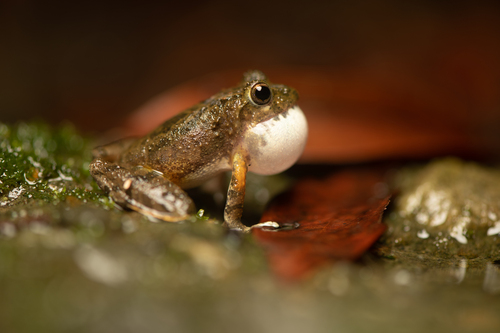
Males perch along stream banks and emit mating calls to attract females. When a female approaches the focal mating male, she signals him to begin amplexus.
Nest Building & Egg Deposition
During mating, the male creates a foam nest, and the female deposits her eggs inside this nest. Peripheral non-mating males have been observed helping to build nests for pairs consisting of a focal male and female.
Post-Spawning Parental Behavior
After spawning, the male usually leaves the female and the egg clutch, and the female covers the clutch with leaf litter.
Nest Dimensions
Completed nests measure 78–112 mm in length and 68–79 mm in width.
Clutch Size
Clutch size ranges from 89 to 206 eggs, based on a sample of 5 clutches.
Individual Egg Size
Individual eggs measure between 2.0 and 3.2 mm, with a mean measurement of 2.8 ± 0.5 mm from a sample of 89 eggs from a single clutch.
Egg Appearance
Eggs are unpigmented and off-white.
Post-Hatching Tadpole Dispersal
After hatching, the tadpoles drop into the water below the nesting tree.