About Kurixalus idiootocus (Kuramoto & Wang, 1987)
Size
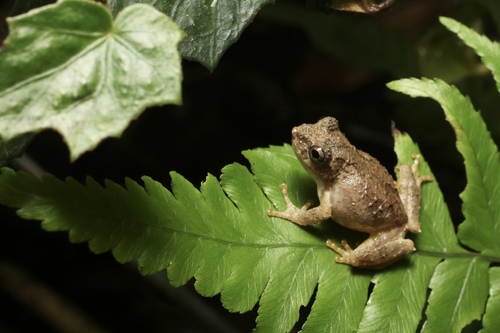
Kurixalus idiootocus is a small tree frog, with an adult body length ranging from 24 to 43 millimetres (0.94 to 1.69 inches). Females of this species are usually larger than males.
Head Shape
It has a broad head with a triangular, pointed snout.
Dorsal Coloration
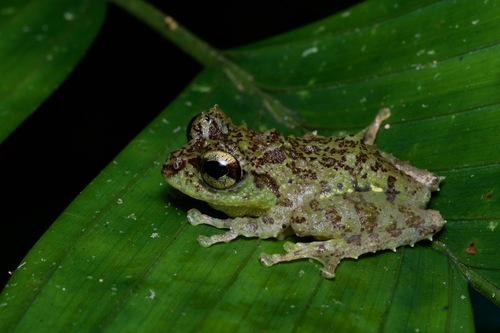
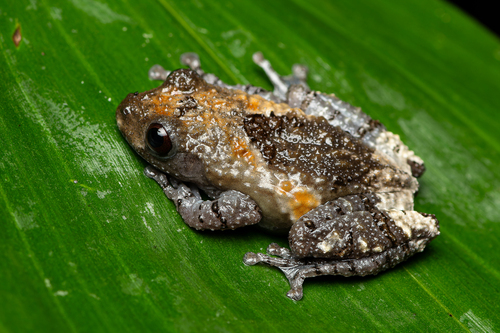
Its body is colored in some shade of pale or medium brown, and has a dark stripe running along its spine.
Body Pattern
The sides of the head and body have a marbled pattern of dark brown patches and spots, and a large, deep brown hourglass-shaped marking often appears on the center of its back.
Skin Texture
The top of its head has tubercles, and its skin has a granulated texture.
Limb Structure
It has flattened discs on its fingers and toes, and has some webbing, with more extensive webbing present on the hind feet.
Distribution Range
This species is widespread across Taiwan, found at altitudes up to 750 metres (2,460 feet) above sea level.
Habitat
It typically lives near still bodies of water, in habitats including paddy fields, damp grassland, and shrubby areas.
Breeding Season
The breeding season of Kurixalus idiootocus runs from March to June.
Male Breeding Behavior
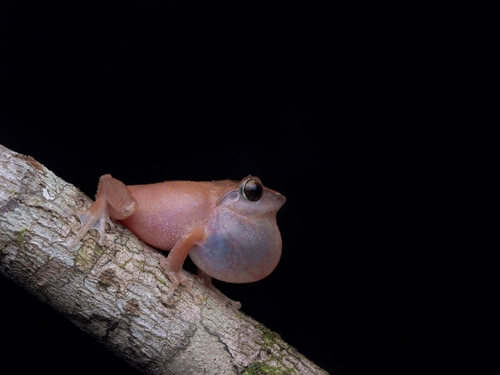
Males aggregate in suitable breeding locations, calling from the ground or low shrubs, and act aggressively toward one another.
Advertisement Call
Their advertisement call is made up of a series of bird-like trills that last several seconds, repeated at regular intervals.
Oviposition Trait
Unusually for frogs, this species deposits its egg masses on land very close to water.
Etymology
In reference to this unusual trait, the specific epithet idiootocus comes from the Ancient Greek words idios, meaning "peculiar", and ootocos, meaning "egg-laying", as explained by the species' original describers Kuramoto and Wang.
Egg Mass Size
Each egg mass contains around 180 eggs.
Egg Coatings
The eggs have two jelly-like coatings: the outer coating is tough and non-sticky.
Oviposition Sites
Eggs are laid in ground depressions, under stones, and in crevices or holes, and are sometimes covered by dead leaves.
Hatching Trigger
Hatching does not occur until heavy rainfall fills the hatching depression with water, or washes the newly hatched tadpoles into a nearby ditch, pond, or temporary pool.
Tadpole Traits
The tadpoles are dark brown, sometimes with black spots, and feed on plant matter.