About Ovis dalli Nelson, 1884
Shoulder Height
Ovis dalli stands about 3 feet (0.9 meters) tall at the shoulder.
Coat Composition
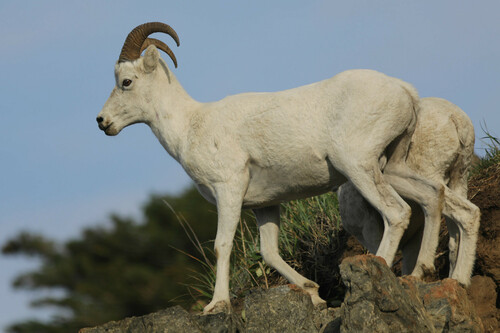
Its overall color is off-white, and its coat is made up of a fine wool undercoat and stiff, long, hollow guard hairs. Winter coats can grow thicker than 2 inches (5 cm).
Lifespan
Individuals of this species typically live 12 to 16 years.
Sexual Dimorphism
Ovis dalli is sexually dimorphic, meaning mature rams (males) and ewes (females) have distinct appearances.
Adult Weight
Rams are larger than ewes; mature rams usually weigh between 160 and 180 pounds (70 to 80 kg), while ewes average between 100 and 110 pounds (45 to 50 kg).
Winter Mass Loss
Over the course of winter, adult sheep can lose up to 16% of their total body mass, and lambs and yearlings can lose as much as 40%, with the amount of loss depending on how severe winter weather is.
Horn Growth Onset
Ovis dalli lambs begin growing horns at around two months old.
Adult Horn Differences
Compared to the massive, curling horns of rams, ewes have small, slender horns.
Young Ram Horn Development
Young rams look similar to ewes until they reach about 3 years of age, at which point their horns begin growing much faster and become much larger than ewes' horns. Adult male Ovis dalli have thick, curling horns, and adult males are easy to identify by their horns.
Horn Growth Rings
Horns grow steadily from spring to early fall each year, creating a start-and-stop growth pattern that leaves visible rings called annuli. These annuli can be used to estimate the individual's age.
Geographic Range
This species of sheep inhabits subarctic and arctic mountain ranges across Alaska, Yukon Territory, the Mackenzie Mountains in the western Northwest Territories, and central and northern British Columbia.
Habitat Preferences
It occupies areas that combine dry alpine tundra, meadows, and steep or rugged terrain; this mix of habitat supports grazing and provides terrain to escape from predators.
Well-known Observation Sites
Populations of Ovis dalli are easily observed along the Seward Highway south of Anchorage, Alaska, within Denali National Park and Preserve (created in 1917 to protect this sheep from overhunting), at Sheep Mountain in Kluane National Park and Reserve, in Tatshenshini-Alsek Provincial Park in northwestern British Columbia, and near Faro, Yukon.
Predators
The primary predators of Ovis dalli are wolf packs, coyotes, black bears, and grizzly bears; golden eagles prey on young lambs.
Anti-predator Behavior
Ovis dalli has been observed pushing gray wolves off the edges of cliffs.