About Ratufa bicolor (Sparrman, 1778)
Species Classification
The black giant squirrel (Ratufa bicolor) is one of the largest squirrel species in the world.
Typical Adult Size
On average, adult individuals weigh 1.05–1.25 kg (2.3–2.8 lb), have a head-and-body length of 34–37 cm (13–15 in), and a tail 41–42 cm (16–17 in) long.
Côn Sơn Island Subspecies Size
The subspecies R. b. condorensis native to Côn Sơn Island, Vietnam, averages around 30 cm (12 in) in head-and-body length and 32 cm (13 in) in tail length, but otherwise matches the appearance of the typical subspecies.
General Color Pattern
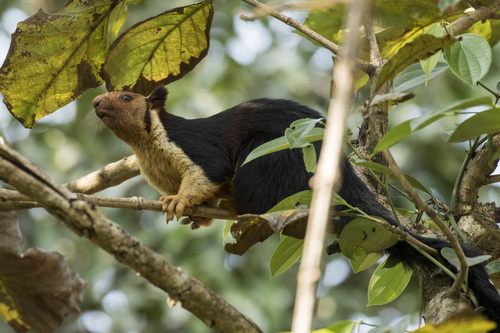
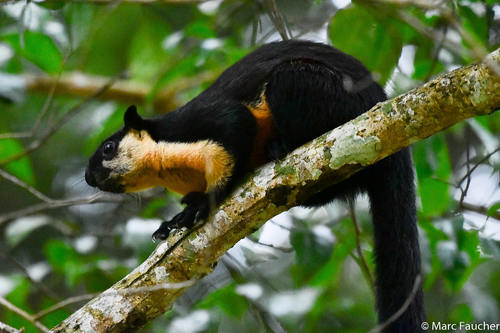
This species is characteristically distinctly bicolored, with dark upperparts and pale underparts.
Core Body Coloration
Its back, the top of the head, ears, and bushy tail range from deep brown to black, while its underparts are light buff-colored.
Sunda Islands Color Variation
In Sumatra, Java, and Bali, the hairs on the back and tail have light-colored tips, which makes these regions appear relatively pale; however, the upperparts, especially the thighs and shoulders, still remain distinctly darker than the underparts.
Myanmar and Strait of Malacca Color Variation
On small islands off Myanmar and in the Strait of Malacca, the black giant squirrel has underparts colored orange to reddish-yellow.
General Habitat Type
All habitats within Ratufa bicolor's range are forested, and the species occurs across a variety of bioregions.
Elevation Range
Its elevation range extends from sea level up to at least 2,500 m (8,200 ft).
Habitat Threats
Over recent decades, R. bicolor's habitat has faced consistent encroachment from human settlement, timber harvesting, and agriculture.
Population Decline
Combined with overhunting by humans across parts of its range, this has caused a total population loss of up to 30% over the past ten years.
Protection Status
In some regions, the species is protected from hunting by law or local tradition.
South Asia Habitat
In South Asia, R. bicolor lives in tropical and subtropical coniferous and broadleaf forests.
Southeast Asia Habitat
In Southeast Asia, it inhabits tropical broadleaf evergreen and semi-evergreen forests, and is rarely found in coniferous forests.
Malay Peninsula and Indonesia Abundance
In the tropical rainforests of the Malay Peninsula and Indonesia, R. bicolor is less abundant than it is in other parts of its range.
Abundance Limiting Factor
This is likely because other arboreal species, especially primates, compete with it for food in the upper forest canopy.
Indian Observation Locations
Good locations to spot the black giant squirrel include Kaziranga National Park in Assam, India, and multiple populations occur in the lower elevation areas of Neora Valley National Park, Kalimpong, India.
Indian Habitat Preference Drivers
A recent study conducted in India found that precipitation in the wettest month of the year is one of the major factors influencing R. bicolor's habitat preference, along with land use and vegetation.
Indian Elevation Records
The species can be found well above 1400 meters in multiple locations across India; more than 20% of its presence records in the country are from elevations above 1500 meters, reaching as high as 2700 meters.
Climate Change Impact Projection
Study predictions indicate that by 2050, climate change could cause the species to lose more than 97% of its current suitable habitat in India.