About Rattus fuscipes (Waterhouse, 1839)
Common and Scientific Name
This species, commonly known as the bush rat (scientific name Rattus fuscipes (Waterhouse, 1839)), has few easy-to-identify traits that set it apart from other Rattus species.
Key Defining Skeletal Traits
Its defining characteristics are small tympanic bullae and a straight incisive foramen.
Distinction from Australian Swamp Rat
Adult bush rats are smaller than the related Australian swamp rat (R. lutreolus); additionally, bush rats have pink foot pads, while Australian swamp rats have dark brown foot pads.
Foot Hair Variation
The hair on the bush rat's foot is short and pale, though the subspecies R. f. coracius is notably darker.
Foot Digit Structure
Bush rat feet are pentadactyl, and all digits have claws.
Tail Morphology
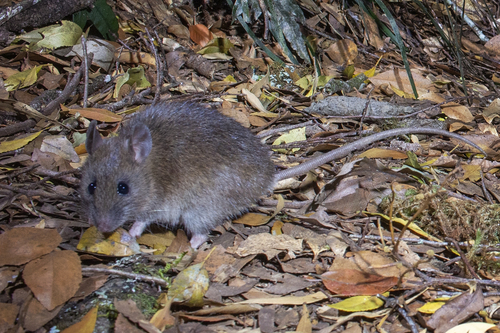
The tail is pinkish brown, almost completely hairless, with overlapping scales that create a clear ringed appearance.
Sexual Dimorphism
Bush rats display sexual dimorphism, with males being larger than females.
Distinction from Cape York Rattus leucopus
They have large, prominent eyes, a trait that distinguishes them from the narrower-snouted Rattus leucopus (Cape York species) where their ranges overlap.
Intraspecific Trait Variation
This species shows wide variation in both coloration and size.
Body and Tail Length
Combined head and body length ranges from 100 to 205 millimetres (3.9 to 8.1 in), and tail length ranges from 100 to 195 mm (3.9 to 7.7 in); these two measurements are roughly equal in individual bush rats.
Pelage Coloration
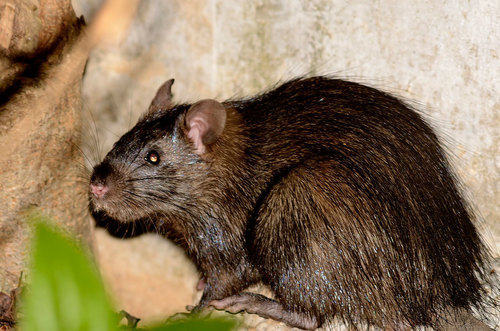
The underside of the pelage is light grey or cream, which blends into the rufous flanks and darker brown upper side, giving the animal an overall greyish or reddish brown color.
Hind Foot and Ear Length
Hind foot length ranges from 30 to 40 mm (1.2 to 1.6 in), and ear length ranges from 18 to 25 mm (0.71 to 0.98 in).
Body Weight
Individual body weight ranges from 50 to 225 grams (1.8 to 7.9 oz), with an average weight of 125 g (4.4 oz).
Teat Count Variation
The number of teats varies across regional populations: females typically have one pair of pectoral teats and four pairs of inguinal teats, but pectoral teats are absent in populations from northern Queensland.
Core Geographic Range
The bush rat is primarily found in the coastal regions of southern and eastern Australia.
Altitudinal Range
It occurs mainly in the lowlands, but can also be found at higher altitudes in the Australian Alps.
Offshore Island Distribution
Its coastal range extends to several offshore islands, including Kangaroo Island.
Southwestern Subspecies Habitat
The southwestern subspecies R. f. fuscipes lives in high-rainfall sclerophyll forests.
Southern and Eastern Subspecies Ranges
Along the southern coast, subspecies R. f. greyii inhabits arid habitat, while subspecies assimilis is found from Victoria to Queensland.
Preferred Terrestrial Habitat
The bush rat is a terrestrial species that prefers wetter areas with dense undergrowth.
Burrow and Nest Structure
It constructs shallow burrows that lead to a nest chamber lined with grass and other vegetation.