About Eudorcas thomsonii (Günther, 1884)
Scientific Name
The scientific name of Thomson's gazelle is Eudorcas thomsonii (Günther, 1884).
Shoulder Height
Thomson's gazelle is a relatively small species of gazelle, standing 60–70 cm (24–28 in) at the shoulder.
Weight
Males weigh 20–35 kg (44–77 lb), while slightly lighter females weigh 15–25 kg (33–55 lb).
Facial Markings
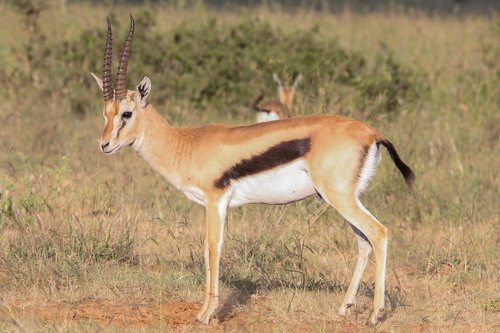
Key facial features include white rings around the eyes, black stripes running from the corner of each eye to the nose, rufous stripes running from the horns to the nose, a dark nose patch, and a light forehead.
Coat Coloration
Its coat ranges from sandy brown to rufous, with a black band running across the flanks from the upper foreleg to just above the upper hind leg, and a buff band located above this black stripe.
Rump and Tail Features
Short black streaks mark the gazelle's white rump, and its solid black tail measures 15–27 cm (5.9–10.6 in).
Scent Glands
Males have well-developed preorbital glands near the eyes, which they use for scent-marking territories.
Horn Shape
Both sexes have horns that curve slightly backward, with their tips facing forward.
Horn Size and Structure
These horns are highly ringed: they measure 25–43 cm (9.8–16.9 in) in males and 7–15 cm (2.8–5.9 in) in females.
Female Horn Variation
Female horns are more fragile than those of males, and some female Thomson's gazelles are even hornless.
Similar Species Distinction
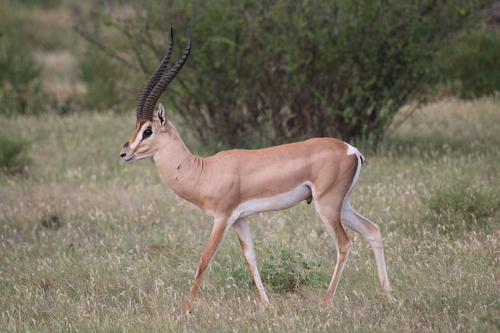
Grant's gazelle is very similar in appearance to Thomson's gazelle, but can be told apart by its larger size and a white rump patch that extends over the top of the tail.
Subspecies Variation Overview
The two recognized subspecies of Thomson's gazelle differ in appearance.
Eastern Thomson's Gazelle Traits
The eastern Thomson's gazelle is the larger of the two, and has fainter facial markings.
Serengeti Thomson's Gazelle Traits
The Serengeti Thomson's gazelle has a whiter face with more conspicuous markings.
Subspecies Horn Differences
In the eastern Thomson's gazelle, female horns are shorter relative to male horns to a greater degree, and the horns are more divergent.
Geographic Range
Thomson's gazelle lives in savannas and grassland habitats in East Africa, particularly in the Serengeti region of Kenya and Tanzania.
Habitat Preferences
It has narrow habitat preferences, favoring short grassland with a dry, sturdy foundation, though it will migrate into tall grassland and dense woodland.
Feeding Type
Thomson's gazelles are mixed feeders.
Seasonal Diet
In wet seasons, they eat mainly fresh grasses, but during dry seasons they consume more browse, especially foliage from woody plants, bushes, and herbaceous forbs.
Population Concentration
They are dependent on short grass, and their populations can become highly concentrated at the start of the rains when grass grows quickly.
Grazing Association
In the Serengeti, Thomson's gazelles follow larger herbivores such as plains zebras and blue wildebeests, which cut down taller grasses.
Lifespan
In the wild, Thomson's gazelles have a lifespan of 10–15 years.
Primary Predator and Escape Adaptation
Their major predator is the cheetah, which can reach higher running speeds, but Thomson's gazelles can outlast cheetahs in long chases and make turns more quickly.
Running Speed and Evasion
This small antelope can run extremely fast, reaching speeds up to 80 km/h (50 mph), and can run in a zigzag pattern—an adaptation that often helps it escape predators.
Additional Predators
Thomson's gazelles are also sometimes preyed on by leopards, lions, African wild dogs, hyenas, Nile crocodiles, and African rock pythons; their fawns are sometimes preyed on by eagles, jackals, and baboons.
Stotting Behavior
A distinctive behavior of Thomson's gazelles is a bounding leap called stotting or pronking, which they use to startle predators and display strength.
Courtship Behavior
During courtship and reproduction, a male gazelle follows a female and sniffs her urine to determine if she is in estrus, a process called the Flehmen response.
Mating Process
If the female is in estrus, the male continues to court her and mount her.
Gestation and Birth Timing
Females leave the herd to give birth to single fawns after a five- to six-month gestation period.
Breeding Seasonality
Breeding occurs year-round, with a peak in births around January and February, and some populations have a second birth peak around June and July.
Newborn Weight
Newborn fawns weigh 2 to 3 kg (4.4 to 6.6 lb).
Reproductive Output
Females can give birth twice per year, producing one or two fawns per litter.
Birth Process
When giving birth, a female gazelle crouches as the newborn fawn drops to the ground, tearing the umbilical cord.
Post-Birth Maternal Grooming
The mother then licks the fawn clean of amniotic fluid and birthing tissues.
Grooming Function
This licking may also stimulate the fawn's blood circulation, or act as a scent label that lets the mother recognize her fawn.
Early Fawn Behavior
For the first six hours of the fawn's life, it moves and rests with its mother, but eventually spends more time away from its mother and hides in the grass.
Nursing Routine
The mother stays near the fawn and returns to nurse it daily.
Fawn-Mother Interaction
Mother and fawn may spend an hour together before the fawn goes back to lie down and wait for the next nursing.
Fawn Group Behavior
Mother gazelles may associate with other mother gazelles, but fawns do not form group nurseries called "kindergartens".
Maternal Defense
Mothers defend their young against jackals and baboons, but do not defend them against larger predators.
Anti-Predator Maternal Behavior
Sometimes a female can fend off a male baboon by headbutting him with her horns to protect her fawn.
Pre-Nursing Vigilance
Before returning to nurse their hidden fawns, females display noticeable peaks in maternal vigilance.
Vigilance Behavior
They stop almost all other activities to focus on watching for danger.
Approach to Fawn Hiding Spot
They move slowly toward the fawn's hiding spot, stopping frequently to scan the surrounding area.
Sham Feeding Behavior
Observations have recorded several females engaging in "sham" feeding behavior, where they lower their heads to the ground as if feeding before quickly raising them back up to scan.
Predator Search Behavior
In one observed case, a female actively searched for predators by climbing to the top of a small hill to scan the area before approaching her fawn's hiding spot.
Fawn Developmental Milestone
As the fawn approaches two months of age, it spends more time with its mother and less time hiding, until it eventually stops hiding entirely.
Weaning Process
Around this age, the fawn begins eating solid food but continues to nurse from its mother.
Herd Integration
The mother and fawn then join a herd.
Young Female Dispersal
Young female gazelles may stay with their mothers through their first year.
Young Male Dispersal
Young males may also follow their mothers, but once they reach adolescence territorial males notice them, so they cannot follow their mothers into territories.
Bachelor Group Formation
The mother may follow and stay with her young male, but eventually stops following him when he is driven away; the young male will then join a bachelor group.