About Ranoidea dayi (Günther, 1897)
Taxonomic Identity
Ranoidea dayi (Günther, 1897) is a small to medium-sized frog that reaches a maximum length of 50 mm (2.0 in).
Dorsal Coloration
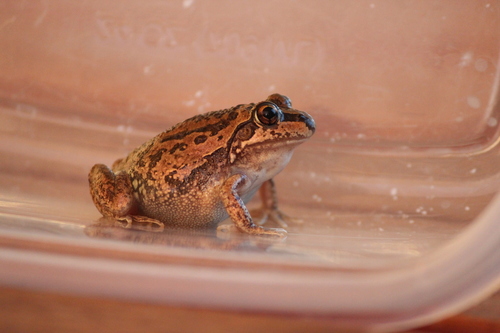
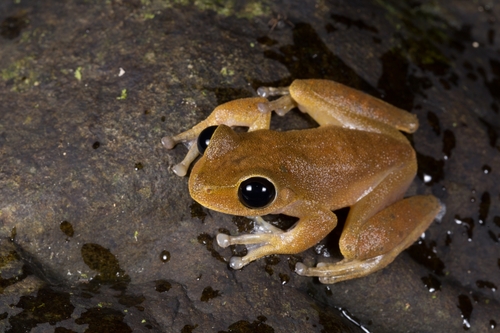
Its dorsal surface ranges from rich brown to orange-brown, and may have scattered cream or lichen-like spots and blotches across the back, head, or limbs.
Limb Markings
The arms and legs have faint barring and a slight fringe along their outer edges.
Ventral Appearance
The belly is cream-white, granular in texture, while the throat and undersides of the arms and legs are black.
Eye Morphology
The iris is dark brown, and the pupil becomes vertical when constricted.
Lower Eyelid Pattern
The lower eyelid is patterned with lines, veins, and dots, which gives the frog its common name.
Webbing Structure
The toes are fully webbed, and the fingers are almost completely webbed.
Tympanum Characteristics
The tympanum is distinct, with its upper quarter covered by a skin fold.
Common Names
Common names for this species include Australian lace-lid, lace-eyed tree frog, and Day's big-eyed treefrog.
Distribution Range
This species is found between Paluma and Cooktown in northern Queensland.
Habitat Preferences
It is most commonly associated with fast-flowing creeks in montane rainforests at altitudes between 0 and 1,200 m (0–3,937 ft), but can also occur around slower watercourses and rock soaks when ample vegetation is present.
Breeding Period
Breeding takes place from spring to summer, with peak breeding activity occurring between October and April.
Male Calling Behavior
Males call from low foliage or rocks near streams, and produce two distinct calls.
Call Variations
When calling in a group, they make a drawn-out "eeeeeeee" repeated three or four times in sequence; when calling alone, they produce a short "ee" every 4–5 seconds.
Egg Characteristics
Eggs are large and unpigmented, laid in clumps of up to 100 eggs attached to submerged objects.