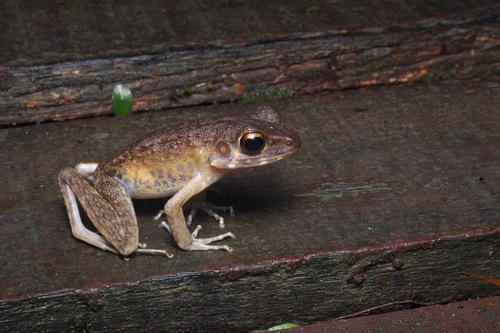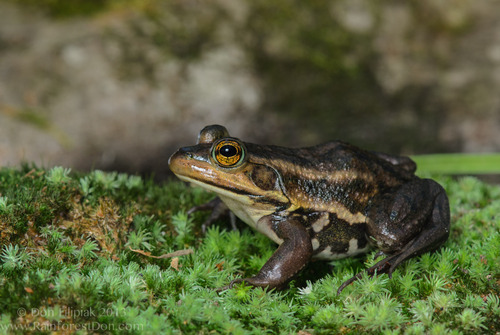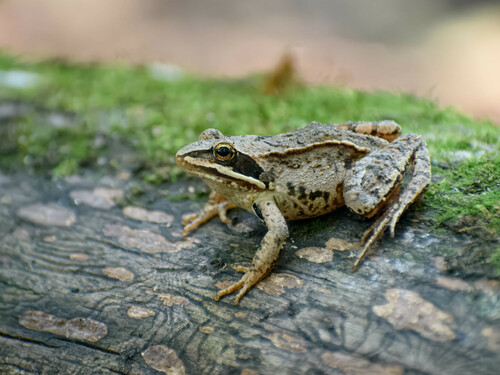
About Rana arvalis Nilsson, 1842
Common Name & Basic Classification
Rana arvalis Nilsson, 1842, commonly called the moor frog, is a small bog frog.
Key Identifying Features
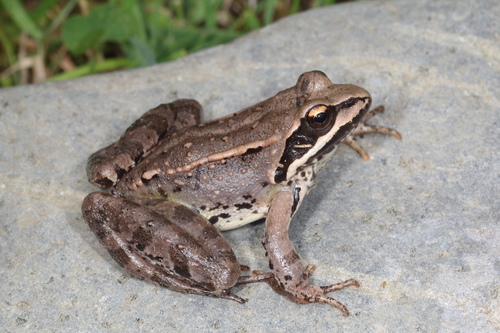
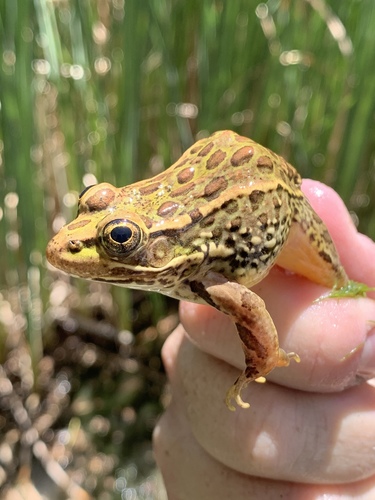
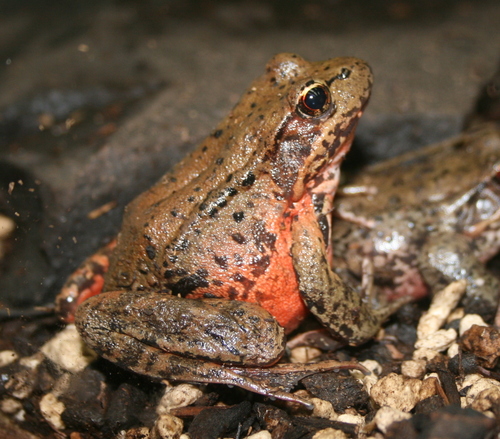
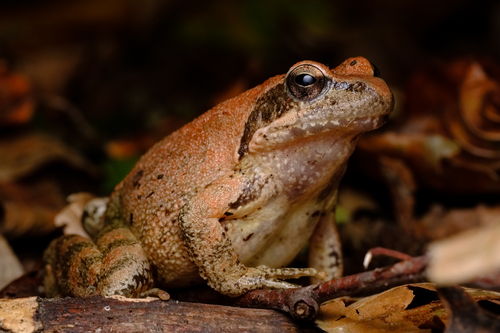
Its key identifying features include a solid-colored belly, a large dark ear spot, and often a pale stripe running down the center of its back. The species is most commonly reddish-brown, but individuals may also be yellow, grey, or light olive.
Additional Morphological Traits
Common traits of the species include white or yellow pigment on the underside, and black stripes that run from the nostrils along the sides of the head.
Adult Body Length
Adult moor frogs generally measure 5.5 to 6.0 cm (2.2 to 2.4 in) in length, and can reach a maximum length of 7.0 cm (2.8 in).
Head Morphology
Their heads are more tapered than those of the common frog (Rana temporaria).
Metatarsal Tubercle Comparison
The most reliable way to distinguish the two species is by examining the metatarsal tubercle, a small spur on the hind foot located next to the innermost toe: in the common frog this structure is soft and small, measuring less than one third the length of the innermost toe, while in the moor frog it is hard and approximately half the length of the innermost toe.
Call Differences
The two species also have different calls.
Breeding Season Male Coloration
During a short period of the breeding season, male moor frogs may turn blue, while male common frogs only develop a faint blueish tint at most.
Additional Body Features
The moor frog has smooth skin on its flanks and thighs, a free forked tongue, horizontally oriented pupils, partially webbed feet, and shorter back legs than other frogs in the same family.
Male Secondary Sexual Traits
Unlike female moor frogs, males have nuptial pads on their first fingers and paired guttural vocal sacs.
Overall Distribution Range
The moor frog is distributed across most of mainland central Eurasia.
Longitudinal Range
Its longitudinal range stretches from northeastern France and northern Belgium eastward to the Lena River in Siberia, in and around the city of Novosibirsk.
Latitudinal Range
Its latitudinal range extends from the 69th parallel in Finland south through the Pannonian Basin and inland Balkans in Central Europe.
Altitudinal Range
The species occurs across a wide range of altitudes: in the western, more European portion of its range, it can be found up to 900 meters (nearly 3,000 feet) above sea level, while further east in areas such as the Altai Mountains, it occurs as high as 2,000 meters (over 6,000 feet) above sea level.
High Elevation Habitat Requirements
At higher elevations, the species is most often found near still or very slow-moving bodies of water surrounded by adequate riparian or littoral vegetation.
Breeding Water Body Characteristics
These water bodies are typically rich in decomposing organic material, giving them a considerably acidic pH that is often at or below 6.
Habitat Plasticity
The moor frog can live in a wide diversity of habitats, demonstrating its environmental plasticity.
Occupied Habitat Types
Habitats it occupies include near-tundra environments, taiga, conifer forest, forest steppe, dry steppe, open forest, glades, chaparral-like arid areas, swamps, meadows, fields, bushland, and private farms or water gardens, though the species generally prefers areas away from humans and predators.
Urban-Adjacent Habitat Presence
Despite this preference, it is adaptable, and is often found in urban-adjacent areas including city-neighboring meadows, bogs, pastures, and public parks.
Research Model Utility
Moor frogs are a good model for studying local adaptation, because they experience a wide range of environments and have relatively limited movement.
Movement and Gene Flow
Their restricted movement limits gene flow, which facilitates evolution through adaptive genetic differentiation between populations.
Earliest Fossil Record
The earliest fossil record of the moor frog dates to between the Pliocene and Early Pleistocene, from a site in Dvorníky-Včeláre, Slovakia.
Early Pleistocene Fossils
Other early Pleistocene moor frog fossils have been found on land within the species' current modern range.
Middle Pleistocene Range
Middle Pleistocene fossil records show the species' range once extended as far south as south-central France and as far west as the eastern coast of Great Britain.
Late Pleistocene Range
Late Pleistocene records show the range extended as far south as Bosnia and Herzegovina and Azerbaijan.
Holocene Range Reduction
During the Holocene, the moor frog also had a wider distribution until the Early Modern period, when widespread land drainage became technologically and economically viable.
Peat-Cutting Impact
Widespread peat-cutting has also impacted the species, particularly at the edges of its range.
Romanian Distribution Regions
In Romania, the moor frog is found in three separate regions. The first is the Transylvanian region, which includes the Western Plains (home to the largest Romanian moor frog population), the Transylvanian Plateau, and the Eastern Carpathians.
Additional Romanian Regions
The second region is northern Romanian Moldavia. The third and smallest region is the Tisa River Basin, north of Maramureș.
Romanian Population Isolation
Most Romanian moor frog populations are isolated and not contiguous due to edge effects from human development.
Romanian Population Sizes
Most populations have 200–400 adult individuals, though exceptional larger populations of 2,000 adults have been recorded.
Romanian Population Altitudes
Most Romanian populations are found between 108 and 414 meters above sea level, with exceptional populations recorded as high as 740 meters above sea level.
Romanian Habitat Types
In Romania, moor frogs live in humid habitats that border land used for human activity, such as flooded agricultural fields, roadside ditches, small canals and streams, and human settlements.
Low-Human-Activity Habitats in Romania
They are rarely found in habitats with little human activity; swamps are one of the few low-human-activity habitats that host the species.