About Aratinga mitrata (Tschudi, 1844)
Scientific Name and Basic Size
The mitred parakeet (scientific name Aratinga mitrata, also referenced as Psittacara mitratus in this text) is 31 to 38 cm (12 to 15 in) long and weighs 219 to 275 g (7.7 to 9.7 oz).
Plumage Sexual Dimorphism
Males and females have identical plumage.
Adult General Plumage
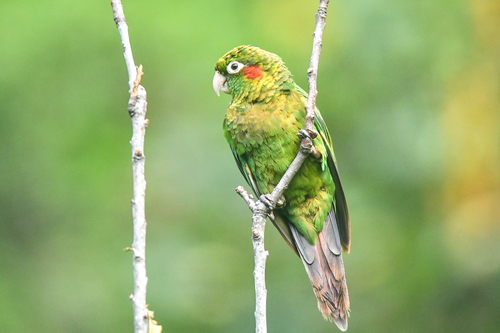
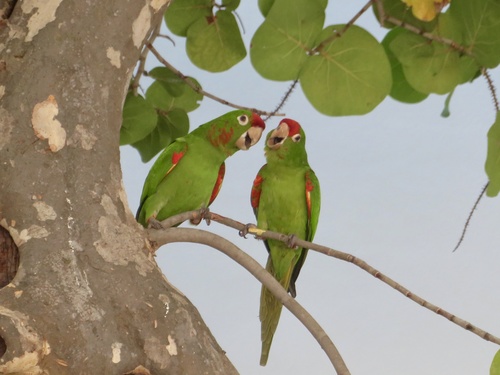
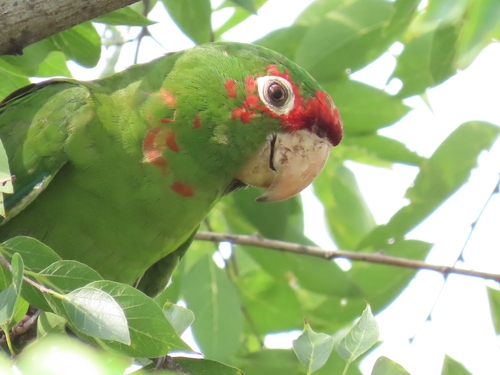
Adults of all subspecies are mostly green, with a purplish forehead and varying amounts and patterns of red on the face. All subspecies have red on the forecrown and red in front of the eye.
Facial Red Pattern Details
The red usually extends past the eye and down the cheeks, and often appears only as flecks on the ear coverts.
Subspecies P. m. chlorogenys Plumage Traits
Subspecies P. m. chlorogenys has less red around and below the eye than other subspecies, often has a blue tinge on the crown, and has some red on the thighs.
Wing and Soft Part Traits
Some individuals of all subspecies have a small amount of red at the bend of the wing. Their eye is surrounded by bare white skin, and their bill is horn colored.
Juvenile Plumage
Juveniles have little to no red plumage.
Plumage Variation Explanations
Observed differences in plumage coloration among wild and preserved birds may be due to incorrect age assignments, and could also be clinal variation.
Subspecies Count
Three subspecies are recognized with distinct native ranges.
Nominate Subspecies Range
The nominate subspecies P. m. mitratus is found from the departments of Ayacucho and Cuzco in Peru, south through Bolivia, into northwestern Argentina as far as Córdoba Province.
P. m. chlorogenys Range
Subspecies P. m. chlorogenys occurs on the eastern slope of the Peruvian Andes between the departments of Amazonas and Junín.
P. m. tucumanus Range
Subspecies P. m. tucumanus is found in the Argentinian provinces of Córdoba and Tucumán.
Introduced Uruguay Population
The mitred parakeet has been introduced to Uruguay, where it has established a wild population.
US Introduced Population Origins
Populations in California, Florida, and Hawaii originate from escaped or released cage birds.
US Introduced Population Official Status
The species does not appear on California's official list of introduced birds, but it is included on the official lists of Florida and Hawaii.
Native Habitat Types
Within its native range, the mitred parakeet inhabits a variety of mostly forested landscapes. These include evergreen montane forest, deciduous montane forest, cloudforest, secondary forest, and semi-humid to humid scrub areas located in otherwise arid zones.
P. m. chlorogenys Elevation Range
Subspecies P. m. chlorogenys occurs at elevations between 1,200 and 2,900 m (3,900 to 9,500 ft).
Other Subspecies Elevation Range
The other two subspecies occupy a wider elevational range, from 1,000 to 3,400 m (3,300 to 11,200 ft), with one recorded sighting at 4,000 m (13,000 ft) in Peru.
Introduced Population Habitats
Introduced populations in California and Florida are found mostly in suburban and urban areas, while introduced populations in Hawaii occur in both populated and unpopulated areas.