About Pyrrhura molinae (Massena & Souance, 1854)
Taxonomy and Basic Measurements
The green-cheeked parakeet, with the scientific name Pyrrhura molinae (Massena & Souance, 1854), measures 25 to 26 cm (9.8 to 10 in) in length and weighs 62 to 81 g (2.2 to 2.9 oz), with males and females of the same size.
Adult Head Coloration
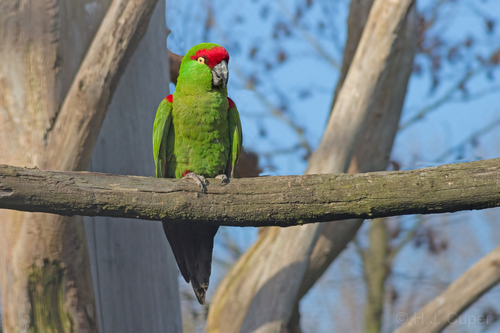
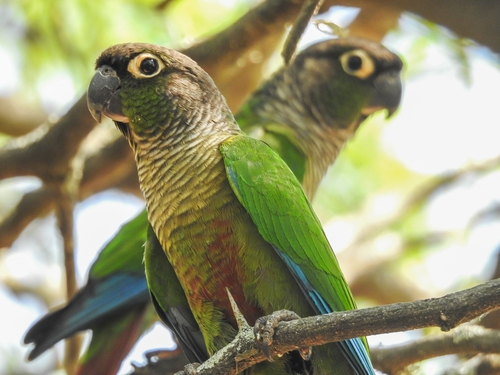
Adults of the nominate subspecies P. m. molinae have dull brown coloration from the forehead to the nape, green cheeks, ashy brown ear coverts, and a creamy white ring of bare skin around the eye.
Adult Upperpart Coloration
Their upperparts are green.
Adult Neck and Throat Patterning
Their chin, throat, and the sides of the neck show scaly brown and whitish patterning.
Adult Underpart Coloration
Their belly is dull reddish, while their lower flanks and vent area are green.
Adult Wing and Tail Coloration
Their wings are mostly green, with bluish flight feathers, and their tail is dull reddish.
Immature Plumage
Immature green-cheeked parakeets are similar to adults, but lack the red belly.
Subspecies Distinguishing Traits
Several recognized subspecies have distinct traits: P. m. phoenicura has green coloration on the upper surface of its tail base; P. m. restricta has a blue collar, a blue tinge on the cheeks, and a smaller red belly patch than the nominate subspecies; P. m. hypoxantha has a paler crown and less distinct breast scaling than the nominate, and a small number of P. m. hypoxantha individuals have mostly yellow underparts; P. m. australis is paler than the nominate and has a larger red belly patch; P. m. flavoptera matches the nominate subspecies in all traits except for orange to red coloring at the bend of the wing and on the carpal edge.
Subspecies Distribution Ranges
Each subspecies has a distinct native range: P. m. flavoptera occurs in west-central Bolivia, in southeastern La Paz and northwestern Cochabamba departments; P. m. molinae is found in Bolivia between La Paz and Chuquisaca departments; P. m. phoenicura is native to northeastern Santa Cruz Department in northeastern Bolivia and southwestern Mato Grosso in Brazil; P. m. hypoxantha occurs in eastern Santa Cruz Department in extreme eastern Bolivia, western Mato Grosso do Sul in southwestern Brazil, and northern Paraguay; P. m. restricta is found in central Santa Cruz Department in east-central Bolivia; P. m. australis ranges from southern Bolivia's Tarija Department into northwestern Argentina, as far as Tucumán Province.
Habitat Preferences
The green-cheeked parakeet inhabits lowland woodlands and forest, primarily deciduous forest, as well as secondary forest and gallery forest in the lower elevations of the Pantanal, and humid subtropical forest up to 2,000 m (6,600 ft).