About Neophema pulchella (Shaw, 1792)
Taxonomy and Size
The turquoise parrot, scientifically known as Neophema pulchella (Shaw, 1792), measures 20 to 22 cm (8–8 3⁄4 in) in length, has a 32 cm (12 1⁄2 in) wingspan, and weighs approximately 40 g (1 1⁄2 oz). It is a small, lightly built parrot.
General Plumage
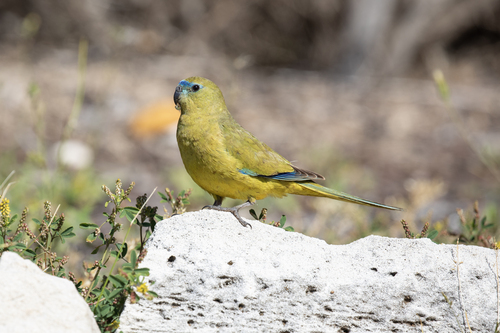
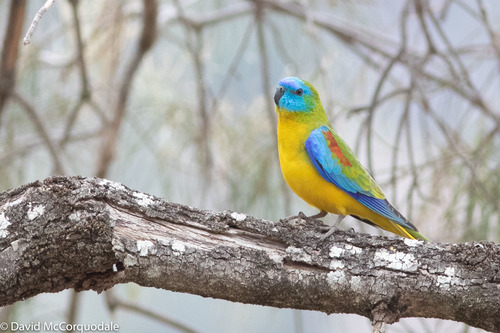
Both sexes have predominantly green upperparts and yellow underparts.
Male Facial and Upperpart Coloration
Males have a bright turquoise-blue face that is darkest on the crown, and slightly paler on the lores, cheeks and ear coverts. Their neck and upperparts are grass-green, and their tail is grass-green with yellow borders.
Male Folded Wing Features
When folded, the wing appears bright blue with a darker leading edge and a red band on the shoulder.
Male Underpart Coloration
The underparts are bright yellow, with a slight greenish tint on the breast and neck. Some males have orange belly patches that may extend up to the breast.
Male Extended Wing Features
When extended, the upper surface of the wing is dark blue with red on the trailing edge, while the underside is black with dark blue leading coverts.
Male Bill and Soft Part Features
The upper mandible of the bill is black, and may fade to grey at the base or not; the lower mandible is cream with a grey border inside the mouth. The cere and orbital eye-ring are grey, the iris is dark brown, and the legs and feet are grey.
Female General Plumage Differences
Females are generally duller and paler than males, with a more uniform, paler blue face, and highly contrasting cream bare skin around the eye.
Female Wing and Torso Features
Females lack the red shoulder band, and their blue shoulder markings are darker and less distinct. Their throat and chest are pale green, and their belly is yellow.
Female Bill Features
The female's upper mandible is paler brown-grey with a darker tip, and has been recorded as black during nesting. The lower mandible is pale grey to almost white.
Female Flight Feature
When flying, females have a broad white bar visible on the underwing.
Juvenile General Features
Juvenile birds of both sexes have less extensive blue on their faces, with the blue color not extending past the eye. Their upperparts match those of adult females.
Juvenile Wing and Marking Features
Both sexes of juveniles have a white wing-stripe, which disappears in males once they reach maturity. Immature males have a red patch on the wing and may also have an orange wash on the belly.
General Distribution
The turquoise parrot is found in the foothills of the Great Dividing Range and the surrounding areas.
Queensland Distribution
Its current northern range limit is at 26° south in southeastern Queensland, around Cooloola, Blackbutt and Chinchilla, extending west to the vicinity of St George. Before 1945, the species was recorded as far north as the Suttor River and Mackay.
New South Wales Distribution
In New South Wales, it occurs across a broad band in the central and eastern parts of the state, with its western boundary marked by Moree, Quambone, Hillston, Narrandera and Deniliquin. There have been unconfirmed sightings in the far west of the state.
Victoria and South Australia Distribution
In Victoria, it is found near Wangaratta, in East Gippsland, and around Mallacoota. Sightings of this species in South Australia are most likely misidentifications of the scarlet-chested parrot, as females of the two species look similar and are easily confused.
Common Habitat Vegetation
The turquoise parrot lives in open woodland and savanna woodland made up of either native cypress (Callitris species) or eucalypts. Common eucalypt species in its habitat include white box (Eucalyptus albens), yellow box (E. melliodora), Blakely's red gum (E. blakelyi), red box (E. polyanthemos), red stringybark (E. macrorhyncha), bimble box (E. populnea), and mugga ironbark (E. sideroxylon).
Less Common Habitat Types
Less commonly, it is found in Angophora stands near Sydney, silvertop ash forest (E. sieberi) in Nadgee Nature Reserve, and stands of river red gum (E. camaldulensis), mountain swamp gum (E. camphora) or western grey box (E. microcarpa) in flatter, more open areas.
Preferred Microhabitat
Within its habitat, the turquoise parrot prefers rocky ridges, gullies, or transitional zones between different habitats, such as the boundary between woodland and grassland, or fields in cultivated areas.
Movement Patterns
The turquoise parrot is considered sedentary and does not migrate, though little is known about its movement patterns. It can be found year-round in some areas, but in northern Victoria it is thought to move to more open areas outside of the breeding season. Some local populations may be nomadic, moving to follow available water sources.