About Platycercus eximius (Shaw, 1792)
Physical Description
Size
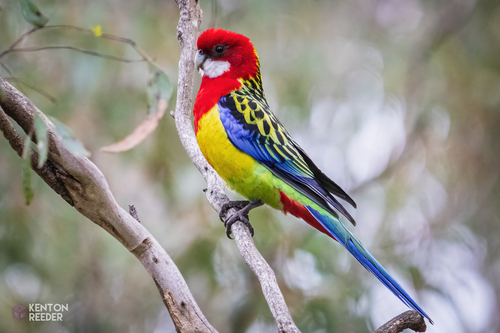
The eastern rosella (Platycercus eximius) measures 30 cm (12 in) in length.
Head Features
It has a red head, white cheeks, a white beak, and brown irises.
Torso Plumage
Its upper breast is red, while the lower breast is yellow, fading to pale green across the abdomen.
Back and Shoulder Markings
Black feathers on the back and shoulders have yellowish and greenish margins that create a scalloped appearance, which varies between sexes and subspecies.
Wings, Tail and Legs
The wings and lateral tail feathers are bluish, the central tail is dark green, and the legs are grey.
Sexual Dimorphism
Females have duller coloration than males and possess an underwing stripe that is absent in adult males.
Juvenile Appearance
Juveniles are duller than females and also have an underwing stripe.
New Zealand Naturalization
Introduction Circumstances
The eastern rosella has become naturalized in New Zealand. Its introduction dates to around 1910, when a small shipment of eastern rosellas and a few crimson rosellas (P. elegans) was denied entry by New Zealand Customs.
Initial Release Events
The ship released the birds off Otago Heads while returning to Sydney; approximately 12 additional birds escaped in Dunedin after their cages were damaged in a gale.
1970s North Island Range
By the 1970s, eastern rosellas were well-established across Auckland, Northland, and the far north of the North Island, extending into western Waikato as far south as Kawhia and Te Kūiti, and east to the Coromandel Peninsula.
Lower North Island Expansion
The species was also present in the Wellington-Hutt Valley Region, and by 1985 it had begun colonizing the foothills of the Tararua Range, extending east to Eketāhuna and west to Ōtaki.
Scattered Sighting Locations
Sightings have also been reported from New Plymouth, Taupō, Gisborne, Tiritea, Banks Peninsula, the Nelson area, and Stewart Island.
Regional Population Contrast
In the South Island's Otago region, the eastern rosella population has remained relatively small, in contrast to the widely distributed North Island populations that currently cover most of the island.
Establishment Origins
The New Zealand meta-population of eastern rosella originated from three main establishment sites: Dunedin, Auckland, and Wellington.
Otago Population History
Early 20th Century Spread
In Otago, eastern rosellas were widespread across Dunedin by the 1930s, and were sighted throughout Otago between the 1940s and 1950s.
Mid-20th Century Decline
From 1950 to the 1970s, sightings in Otago declined and the population was recorded to be decreasing.
Decline Causes
This population drop was attributed to strychnine-grain poisoning targeting rabbits, as well as human trapping of wild birds for aviary collections.
Post-1980s Recovery
Since the 1980s, increased sightings of the species indicate the eastern rosella population around Dunedin has recovered.
Auckland Population Spread
1960s Range
In Auckland, eastern rosellas were mostly spread across mid to upper Northland in the 1960s.
1970s Southward Expansion
By the 1970s, the species had spread into Waikato, then later into Coromandel, the Bay of Plenty, and Taranaki.
Coromandel Colonization Route
Records of eastern rosellas in mid-Coromandel and Waiheke Island from 1975-1976 suggest the species spread to the Coromandel Peninsula from Waikato.
Taranaki Expansion Origin
During early expansion into Taranaki, the species was more commonly recorded in Waikato than Manawatū, indicating the Taranaki eastern rosella population expanded southward from Auckland.
Current Western North Island Status
Recent observations confirm the species is continuously present across western North Island.
Wellington Population Dynamics
Spread to Adjacent Areas
Population growth of eastern rosellas in Wellington allowed further spread into northern Wellington, Manawatū, and Waitapa, confirmed by their establishment and regular sightings in these areas.
Island Absence
No eastern rosellas have been sighted on Kapiti or Mana Islands.
Waikanae Breeding Population
A wild breeding population exists around Waikanae, with breeding sites located in bush areas near the beach.
Habitat Preferences
General Elevation Preference
Eastern rosellas generally prefer to live in lowland areas.
New Zealand Habitats
In New Zealand, they occupy edges or remnant patches of open woodland and forest, around shelter belts, former gumlands, and orchards.
Rural and Urban Occupancy
They are also frequently seen in areas with cultivated exotic crops and in urban town areas.
Urban Microhabitats
In more urban settings, the birds inhabit well-maintained lawns, such as those in gardens and golf courses.
Cross-Range Habitat Favourites
Across both Australia and New Zealand, eastern rosellas favour open areas and agricultural lands.