About Pulsatilla occidentalis (S.Watson) Freyn
Nomenclature
Pulsatilla occidentalis, synonym Anemone occidentalis, is commonly known as white pasqueflower or western pasqueflower. It is a herbaceous flowering plant species that belongs to the buttercup family, Ranunculaceae.
Plant Size and Basal Leaves
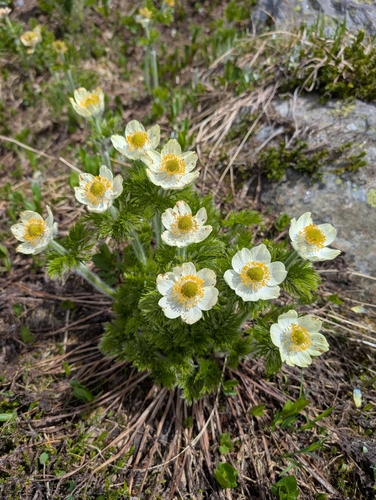
Plants grow 10 to 60 cm (3.9 to 23.6 in) tall from caudices, and produce three to six 3-foliolate leaves at the base. Each leaflet is pinnatifid to dissected in shape.
Leaf Petiole and Pubescence
Leaf petioles measure 6 to 10 cm (2.4 to 3.9 in) long, and leaves are covered in villous hairs with pinnatifid or dissected margins.
Flowering Period
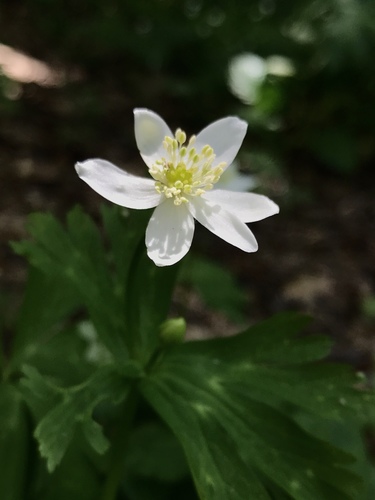
Flowering occurs for a short period from mid-spring to mid-summer, typically soon after melting snow exposes the ground. Each stem produces only one flower, which is made up of five to seven sepals, sometimes referred to as tepals.
Sepal Coloration
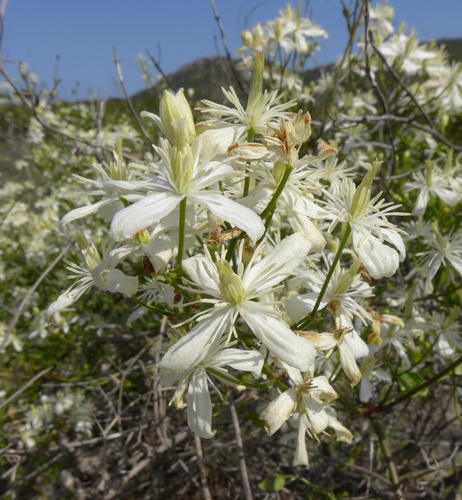
Sepals are most often white or soft purple, but may also be a mix of white and blueish purple.
Sepal and Stamen Dimensions
The sepals are 15 to 30 mm (0.59 to 1.18 in) long and 10 to 17 mm (0.39 to 0.67 in) wide, and flowers contain between 150 and 200 stamens.
Fruit Head Structure
Fruits develop in heads that are rounded to subcylindric in shape, held on pedicels 15 to 20 cm (5.9 to 7.9 in) long. The achenes are ellipsoid and non-winged, covered in villous hairs.
Achene Beak Characteristics
They feature curved beaks that reflex as they age; the beaks are 20 to 40 mm (0.79 to 1.57 in) long and have a feather-like appearance. Fruits generally persist on the plant into fall.
Species Distribution
This species is native to far western North America, ranging from British Columbia south to California and east to Montana.
Habitat
It grows in gravelly soils on slopes and in moist meadows.
Traditional Uses
In traditional North American medicine, the fresh stems and seeds of this plant are used as analgesics, anxiolytics, and sedatives.