About Ptychoramphus aleuticus (Pallas, 1811)
Taxonomic Classification
Cassin's auklet (Ptychoramphus aleuticus) is a small, chunky seabird with a wide range across the North Pacific. It is the only species classified in the genus Ptychoramphus.
Nesting and Documentation Status
This bird nests in small burrows, and because it occurs on well-studied islands in British Columbia and off the coast of California, it is one of the better-documented auk species. It is named after John Cassin, an American ornithologist.
Size Measurements
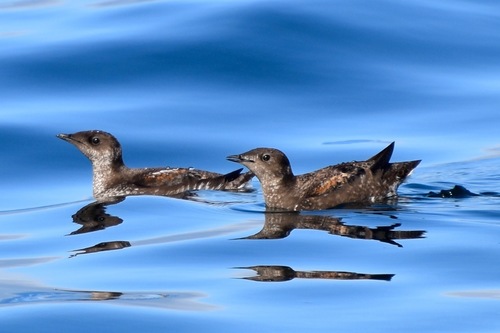
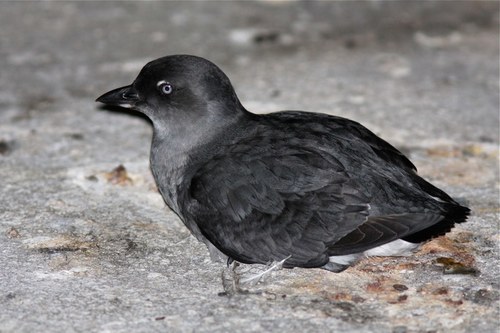
Cassin's auklet is a small, nondescript auk, measuring 25 cm in length and weighing around 200 g. Its plumage is generally dark on the upper body and pale on the lower body, with a small white marking above the eye.
Physical Features
Its bill is mostly dark with a pale spot, and its feet are blue. Unlike many other auks, Cassin's auklet does not have dramatic breeding plumage, and its appearance stays mostly the same throughout most of the year.
Flight Identification
At sea, it is usually identified by its flight, which is described as resembling a flying tennis ball.
Geographical Range
The range of Cassin's auklet extends from the middle of the Baja California peninsula to Alaska's Aleutian Islands, off the coast of North America.
Nesting Population Stronghold
It nests on offshore islands, with the main population stronghold located at Triangle Island off Vancouver Island's Cape Scott, where the population is estimated to be around 55,000 breeding pairs.
Movement Pattern
The species is not known to be migratory, though northern populations may move further south during the winter.
Recognized Subspecies
Two subspecies are currently recognized: P. a. aleuticus (Pallas, 1811), found from the Aleutian Islands and southern Alaska to northern Baja California, as well as the Kurile Islands; and P. a. australis (van Rossem, 1939), found in southern Baja California.
Fossil Relative
An extinct relative or predecessor species, Ptychoramphus tenuis L. H. Miller et Bowman, 1958, is known from fossil remains from the Late Pliocene of the San Diego Formation in California.