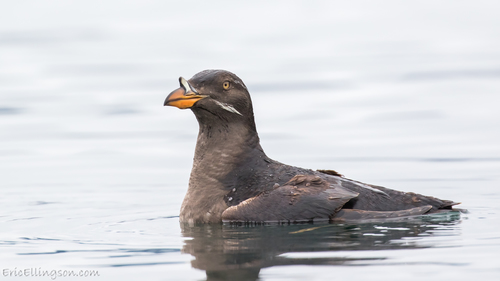
About Cerorhinca monocerata (Pallas, 1811)
Taxonomy and Naming
The rhinoceros auklet, scientifically named Cerorhinca monocerata, is a seabird and a close relative of puffins. It is the only living species in the genus Cerorhinca. Due to its close relationship with puffins, the alternative common name "rhinoceros puffin" has been proposed for the species.
General Range and Diet
It has a wide range across the North Pacific, where it feeds on small fish and nests in colonies.
Beak Horn Nomenclature
The species gets its name from a horn-like extension on its beak; the anatomical term for this extension is the rhamphotheca.
Horn Characteristics
This horn is only present in breeding adults, and like the elaborate bill sheath found on puffins, it is shed every year. The horn also has fluorescent properties, which are likely used for reproductive signalling.
Common Alternate Names
The rhinoceros auklet, also called rhino auklet, horn-billed puffin, or unicorn puffin, is a medium-sized auk with a large, strong, orange/brown bill that bears the characteristic horn.
Plumage
Its plumage is dark on the upper body and paler on the underparts. Breeding adults of both sexes have white plumes above the eyes and behind the bill.
Sexual Dimorphism
Males are slightly larger than females, with an approximately 10% difference in body mass.
Breeding Distribution
The rhinoceros auklet is a North Pacific auk that breeds in North America from California's Channel Islands to Alaska's Aleutian Islands; in Asia, it breeds on Hokkaidō and Honshū in Japan, the Korean Peninsula, and Sakhalin Island.
Winter Habitat and Migration
It spends the winter in both offshore and inshore waters, and shows some migratory movement.
California Migrant Populations
Large numbers of rhinoceros auklets migrate to pelagic California waters between October and April; most of these migrating birds come from breeding colonies located north of California. Auks that already live off the California coast stay in their existing areas year-round.