About Aethia cristatella (Pallas, 1769)
Size Measurements
The crested auklet (Aethia cristatella) measures 18–27 cm (7.1–10.6 in) in length, has a 34–50 cm (13–20 in) wingspan, and weighs 195–330 g (6.9–11.6 oz).
Adult Body Coloration
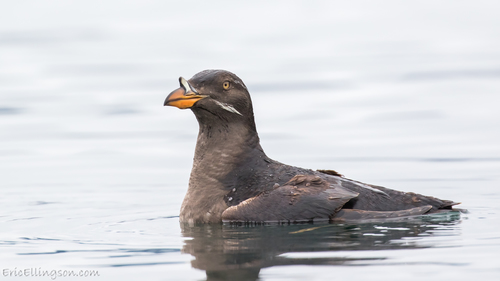
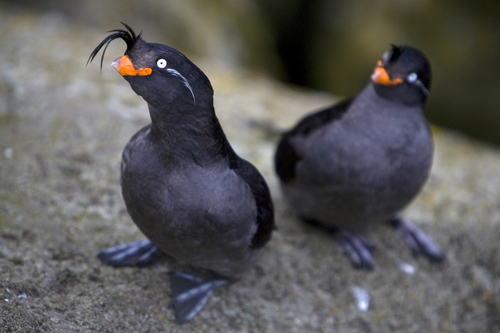
It has a reddish-orange bill with a yellow tip, yellowish-white irises, and white auricular plumes that extend from its eyes to its ears. Its body, wings, and tail are primarily dark sooty grey; its legs and feet are grey, and its claws are black.
Sexual Dimorphism
Males and females are very similar in appearance, though females have slightly smaller, less curved bills and slightly smaller crests.
Forehead Crest Composition
Crested auklets are best known for their forehead crests, which are made of black, forward-curving feathers. These crests are highly variable, holding between 2 and 23 narrow forward-curving feathers.
Crest Feather Details
The average crested auklet has 12 crest feathers, which vary in length from 8.1 to 58.5 millimetres.
Bill Accessory Plates
In addition to auricular plumes, crested auklets have a bright orange bill with curved accessory plates. Like the forehead crests, these features vary widely between individuals in crested auklet populations.
Breeding Season Identifiers
Two key characteristics identify crested auklets during the breeding season. The first is the crest itself: a group of bristle feathers located on top of the head above the eyes.
Breeding Season Odor
The second is a social odor the birds produce during the breeding season, which is described as smelling like tangerines. This odor comes from tiny wick feathers in a small patch of skin between the shoulder blades.
Winter Plumage Traits
In winter plumage, crested auklets have smaller, dull yellow bills, lack accessory plates, and have reduced crests and auricular plumes.
Juvenile Appearance
Juvenile crested auklets look similar to winter adults, but have no auricular or crest plumes. Their bills are smaller and dull brownish-yellow in color.
Juvenile Growth
Juveniles take 33 days to reach adult size.
General Distribution Range
Crested auklets are found across the northern Pacific Ocean and Bering Sea.
Non-Breeding Range
During the non-breeding winter months, they are particularly common along the Aleutian Islands, Kuril Islands, and the Russian island of Sakhalin.
Breeding Season Range
In late spring and summer, they travel to breeding sites on the islands and shorelines of the Sea of Okhotsk and the Bering Sea.
Habitat Types
Their habitats include slopes, boulder fields, lava flows, and sea cliffs.
Associated Species
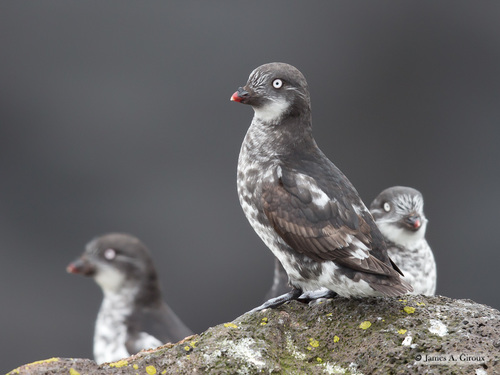
They are often found alongside other auklet species, such as the least auklet.
Circling Behavior
Each day, crested auklets circle 500 meters above the sea and their breeding colonies. This circling behavior is triggered by disturbances and threatening predators.