About Ramphastos brevis Meyer de Schauensee, 1945
Species Nomenclature
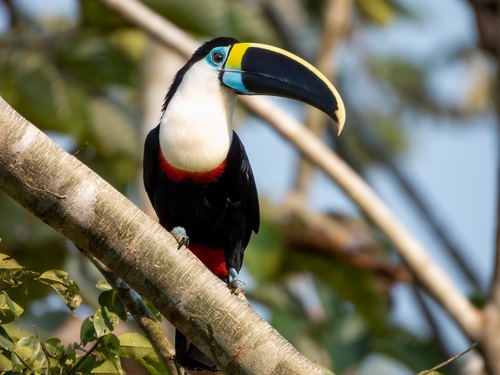
Ramphastos brevis, commonly known as the Choco toucan, measures 46 to 48.5 cm (18 to 19 in) in length and weighs 365 to 482 g (13 to 17 oz).
Sexual Dimorphism
The sexes have similar plumage, though the female’s bill is shorter than the male’s.
Maxilla Coloration
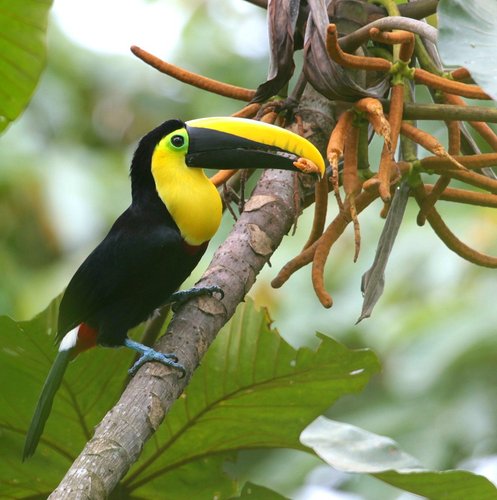
The species’ maxilla (upper bill) is mostly yellow, with some green on the culmen and a black triangle at the base.
Mandible Coloration
Its mandible (lower bill) is black, and sometimes has a yellow tip.
Head and Upperpart Plumage
The Choco toucan’s crown and nape are black with a maroon tinge; its upperparts and tail are black, with the exception of white uppertail coverts.
Ocular Skin Color
Bare yellow-green to olive green skin surrounds its eye.
Underpart Plumage
Its throat and breast are yellow, with a narrow red band below the breast. Its belly is black, and its undertail coverts are red.
Similar Species Distinction
The plumage of the Choco toucan is almost identical to that of R. a. swainsonii, the chestnut-mandibled subspecies of the yellow-throated toucan, whose range overlaps with that of the Choco toucan, but the two species can be distinguished by their calls.
Geographic Range
As indicated by its common name, the Choco toucan is found only in the humid Chocó region, ranging from northwestern Colombia to southwestern Ecuador.
Habitat Types
It primarily lives in lowland and foothill forest, but also occurs in pastures and plantations with fruiting trees adjacent to forest.
Elevation Range
It can be found at elevations up to approximately 1,550 m (5,100 ft).