About Pteroglossus bailloni (Vieillot, 1819)
Common Name and Size
Pteroglossus bailloni, commonly called the saffron toucanet, is a relatively long-tailed toucan with a total length of 35–40 cm (14–15.5 in).
Overall Plumage Color
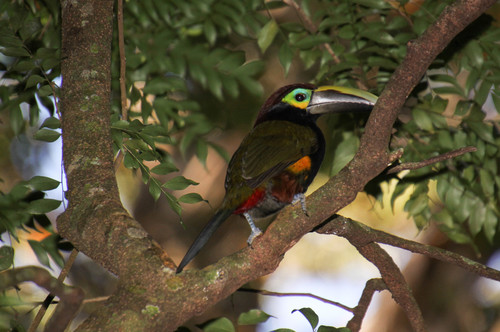
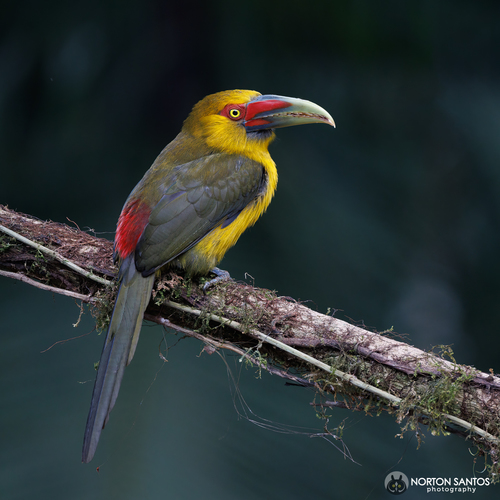
As its common name suggests, it is unique among toucans for being overall saffron yellow. Its back and tail are darker, with a more olive color.
Distinctive Colored Features
Its rump, ocular skin, and patches on the basal half of its otherwise greenish-horn bill are red. Its iris is pale yellowish.
Sexual Dimorphism Overview
This species is sexually dimorphic, meaning males and females have distinct appearances.
Adult Male Appearance
The adult male has a golden head and breast, an olive mantle (covering the wings, shoulder feathers, and back), and a red rump. It has a modestly sized bill, colored green, grey-blue, and yellowish-grey across its length.
Adult Female Appearance
Adult females are similar to males but have more olive and less gold coloration, and also have a shorter bill.
Juvenile Appearance
Juvenile saffron toucanets are mostly olive and grey, with brown eyes and a blotchy bill.
Species Distribution
The saffron toucanet is found in the Atlantic Forest.
Taxonomic Grouping
It belongs to the Pteroglossus viridis superspecies group, which separated from other Pteroglossus groups around 3 million years ago. Phylogenetic study topologies confirm the saffron toucanet is a member of the Pteroglossus viridis group, rather than a sister lineage to all other Pteroglossus.
Biogeographic Separation
The saffron toucanet is separated from other species in the viridis group by the Brazilian savanna biome. It is thought this species comes from an ancient stock that became isolated in the modern Atlantic Forest due to marine transgression, and was not able to adapt to or invade the Brazilian savanna.
Habitat Requirements
It depends entirely on forested habitats to survive.
Sensitivity to Forest Fragmentation
A study investigating whether Atlantic Forest endemic species with small geographic ranges are more vulnerable to forest fragmentation found this species is endemic and has high sensitivity to fragmentation, meaning it is more likely to be negatively affected by forest splits. It also found that species at the edges of their ranges are sensitive to fragmentation, which may occur because there are fewer nearby populations to recolonize areas after local populations are lost.
Ecological Role as Frugivore
The saffron toucanet is a large-gape frugivore. Because of this trait, it is especially important for dispersing the seeds of plants that produce larger seeds to more distant areas, and it is one of the few bird species capable of carrying larger seeds to new locations.
Ecological Network Contribution
One study indicates there is a strong association between a species' contribution to network modularity and its number of interactions. Species with many links tend to form interactions both within and between environments, and make a greater contribution to nestedness.
Extinction Risk Implications
On average, species that contribute more to network organization, like the saffron toucanet, face a higher risk of extinction. Losing this species' connections to specific plant species could lead to ecological and evolutionary consequences such as co-extinction.
General Diet
The saffron toucanet's diet mainly consists of fruit, including figs and palm fruits. It has also been recorded eating young birds.
Red-rumped Cacique Nest Predation Observation
In one study, a saffron toucanet was observed entering a red-rumped cacique nest, swallowing the nest contents, and flying away, all within 30 seconds. Researchers think its smaller body size allows it to perch on the nest and enter and exit quickly.
Woodpecker Nest Attack Observation
Another study recorded one saffron toucanet making an unsuccessful attempt to attack the nest of a white-spotted woodpecker.