About Pterocles gutturalis A.Smith, 1836
Physical Adaptations
This species, Pterocles gutturalis (yellow-throated sandgrouse), has long, pointed wings adapted for long-distance flight. Most of its body and legs are covered in feathers, which reduces heat gain via convection.
Size
Males and females are similar in size, with an average weight of 350 g (12 oz) and an approximate height of 30 cm (12 in).
Adult Plumage
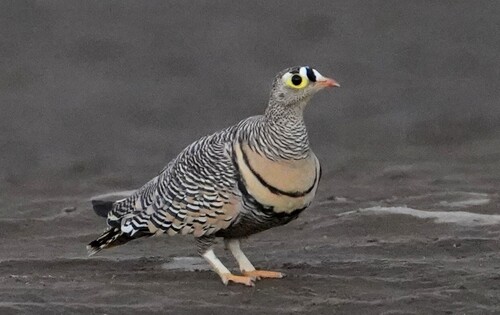
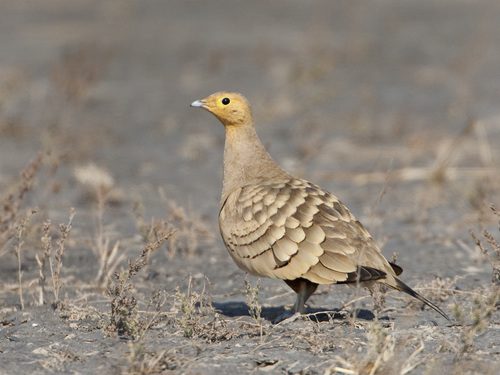
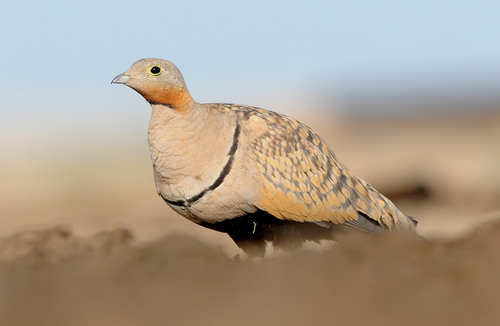
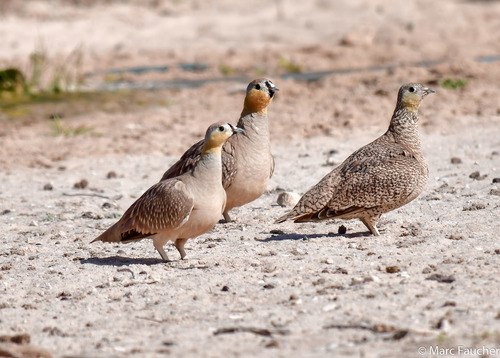
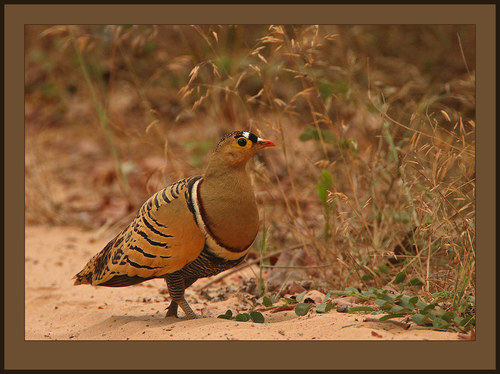
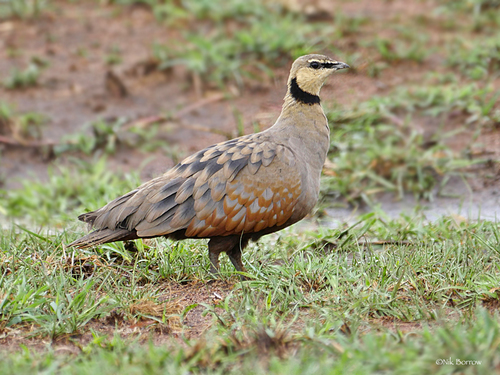
The two sexes differ noticeably in their plumage: males have brighter coloration, with black collars, lores, and underwing coverts, while females have paler, more cryptically colored plumage.
Juvenile Plumage
Juvenile plumage resembles that of females, but has a finer mottling pattern.
Subspecies Plumage
The two recognized subspecies also differ primarily in plumage: P. g. saturatior has brighter, cinnamon-colored upperwing-coverts.
Habitat Types
Yellow-throated sandgrouse lives in open grasslands, farmlands, and the edges of arid areas.
Soil Preferences
It favors clay-rich soils, and avoids coarser sandy or rocky soils formed from quartzite and granite.
Distribution Pattern
The species has a disjunct distribution that follows arid corridors.
Nominate Subspecies Range
The nominate subspecies P. g. gutturalis is found in Angola, southern Zambia, western Zimbabwe, Namibia, Botswana, and northern South Africa.
P. g. saturatior Range
P. g. saturatior occurs from Tanzania to northern Zambia, and across southern Ethiopia through Kenya.
P. g. saturatior Movement
P. g. saturatior is mostly sedentary.
Nominate Subspecies Movement
South African populations of the nominate subspecies are also sedentary, while populations in Namibia and Botswana are migratory; overall, P. g. gutturalis is mostly migratory, as regional flood patterns force the birds to move.
Breeding Timing
The breeding season for this species runs from March to October.
Courtship Knowledge
While courtship behavior has been recorded in pairs of P. g. gutturalis, written descriptions of these rituals are scarce and inconsistent compared to what is known for other sandgrouse species.
Nest Construction
To build their nest, a breeding pair scrapes out a depression in the soil, then lines it with dry weed stems or dry grass.
Nest Placement
When vegetation cover is available, pairs will choose a nest spot next to this cover. Nests from different pairs can be found 40 to 45 meters apart in the same open field.
Egg Development Traits
Eggs of this species are relatively small, which lowers parental energy investment and shortens the combined laying and incubation period, which totals approximately 30 days.
Eggshell Adaptations
Eggshells have a reduced pore area that limits water loss in arid environments.
Reproductive Productivity
The mean clutch size is 2.85 eggs, and average annual productivity is estimated at 0.42 to 0.85 young per breeding pair.